
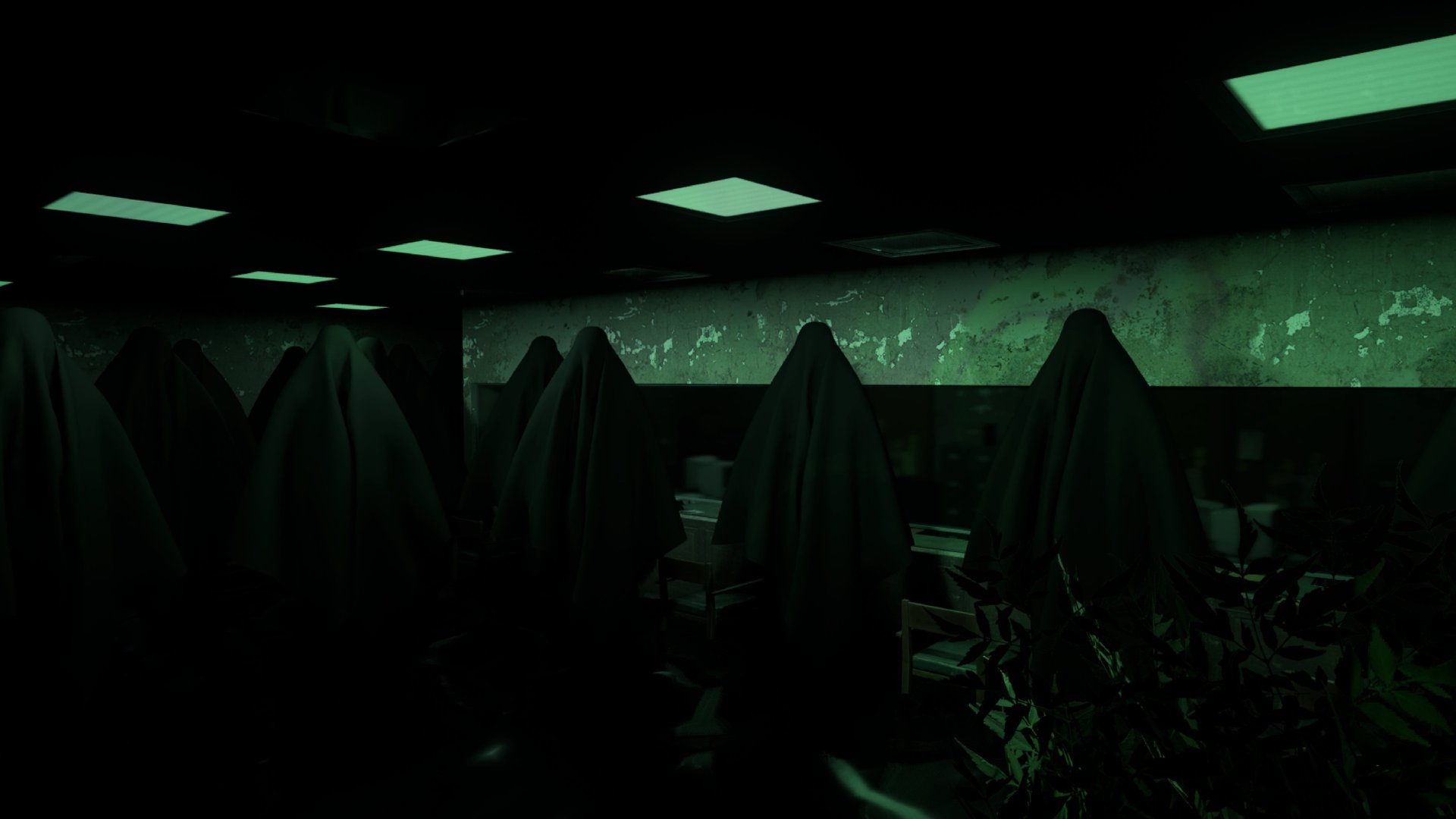
GW: Black Puddle
Mystery, Suspense, Psychological, Drama
Notes:
This game writing project was made streamlined as the level design of Black Puddle was made, so the playtesting phase on the level design directly affects the workflow and the game writing progress.


Besides being my first UE5 game project, this was the first project/origin of Taksa Semesta (original universe) and was explored through the perspective of the 10th owner of Taksa Semesta's object. This universe also got explored in my second project, Future Siren.
Overall View
Straight up, I needed to make a portfolio to enter the game industry. And, since I’m new to this field (I started to learn about gamedev back in mid-2023), it’ll be more effective if I start by making something familiar to me: linear storytelling with mystery, crime, psychological & a bit philosophical genres.
The first idea for this project came when I was exercising top-down layout to make a level design. The idea back then was an ordinary detective game where you come to a crime scene, investigate a murder case, combat, and run so the monsters don’t catch you. But, it has a twist where the human environment changes into a monster-like universe where dead people covered in white clothes are levitating on the road like a cult.
This idea of cult-like monsters mixed with crime investigation piqued my interest, so I continued to develop it until it became a monster universe named Taksa Semesta, which was heavily inspired by the dark sides of human and Indonesian cultures.
I wanted to make two universes: human and monster. For the human universe, I used a familiar setting for the crime-mystery detective genre, which takes place in an American/European country and uses English as its main language.
That means the monster universe should be distinguishable from those concepts. Then, I remember, I’m Indonesian. Indonesia has TONS of differences with those countries.
I also had adequate resources and the capability to adapt Indonesia-related data into story ideas while lowering the risk of misinterpretation or disrespect caused by a language barrier. So, it was decided, the monsters' universe will take inspiration from Indonesian-related data.
After some research, I decided to subtly show the monsters' characteristics through the name of the monsters' universe itself: Taksa Semesta.
Taksa = mempunyai makna lebih dari satu (Bahasa Indonesia), which translates to it has more than one meaning.
Semesta = sinonim dari alam/dunia (Bahasa Indonesia), which translates to synonym of nature/universe.
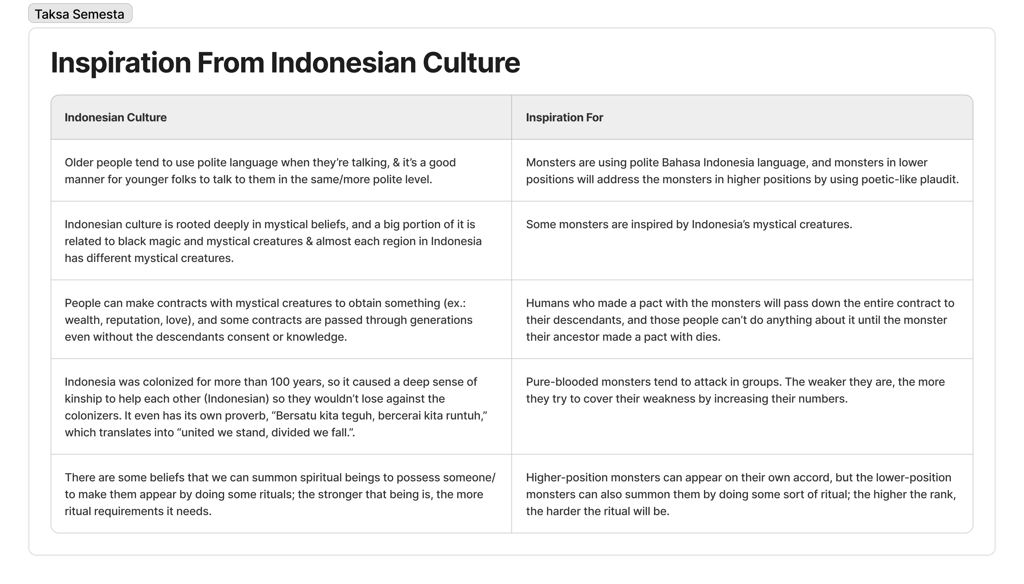
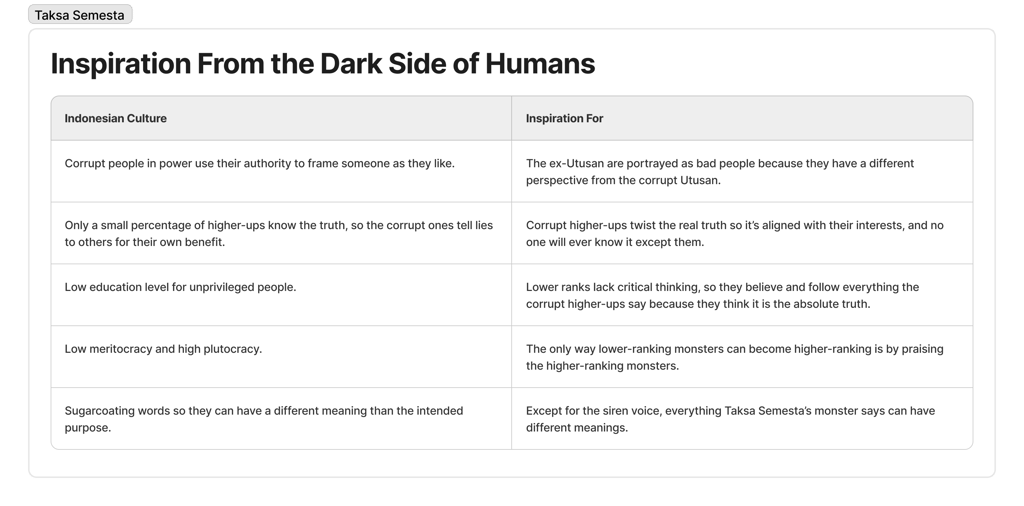
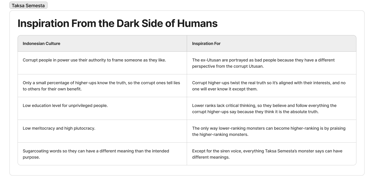
To make the story understandable for the player, I used a psychological theme for the monster's universe: the dark side of humanity. I did this to make sure everything has a deeper meaning, which later can be used to expand the story.
Taksa Semesta: High-level concept
Besides brainstorming, I did tons of research to make the story have a deeper meaning than what only appears on the surface. I noticed the morality conflict that became the fundamental in this universe was fitting with the concept of 7 deadly sins and 7 heavenly virtues, so further improvement can be done as long as it follows those categories. I also found some good music that greatly inspired me:

.Feast - Gugatan Rakyat Semesta
Inspiration for: the start of the revolution from the kind monsters by collaborating with humans to kill the corrupted monster leader and its underlings because of their immoral nature.

Alan Wake 2 OST - Ahti - Yötön Yö
Inspiration for: humans have intelligence and emotion, which makes them better beings than the pure-blooded Taksa Semesta monsters, that's why they're getting stronger when they eat humans.

Unlike Pluto - Oh Raven
Inspiration for: butterfly effect from people in the past who eradicated the descendants of humans who made packs with Taksa Semesta monsters. It becomes an irony when, in the present time, the remaining descendant must save the lineage of people who killed their ancestors.
Lathi ~ Weird Genius ft. Sara Fajira
Inspiration for: only the descendants of humans who made packs with Taksa Semesta monsters understand the meaning of the monster's plaudit, while normal humans can only hear it but don't understand the meaning.

Nathan Wagner - Paranoia
Inspiration for: weak mental state from becoming an owner of Taksa Semesta’s object, and when the descendants of humans who made pacts with Taksa Semesta monsters awakened their powers.
tAKSA sEMESTA: sONG INSPIRATIONS
Taksa Semesta: Backstories


History of Taksa Semesta
First of all, I established the history between the monsters and their world to give the bigger picture about the different monsters' tendencies and how they impacted their civilization.
Mostly, the inspirations came from various ideologies and how different beings perceive them. It got implemented through different moral compasses, which widened to polar opposite approaches to ideas, problem solving, traditions, and everything else.
Political play and power hierarchies that got tarnished by ego elevated the tension and created internal war between monsters, eventually leading to morally corrupt monsters winning the war and taking over the civilization.
Monsters Invading The Earth Cycles
After the corrupt monsters took over Taksa Semesta, the universe borders became unbalanced, letting the monsters go to the earth. Since humans were better beings, it strengthened them when they ate humans. And it gave them motivation to eat humans and take over the earth.
Taksa Semesta’s monsters know about this history since they have a long lifespan, but it’s a long-forgotten history for humans.
So, when the monsters invade the earth for the second time in this story, the player, as the protagonist, didn’t know anything about it, and it became one of the main missions in the main game: uncover the history and find out why it was hidden from modern human civilization.
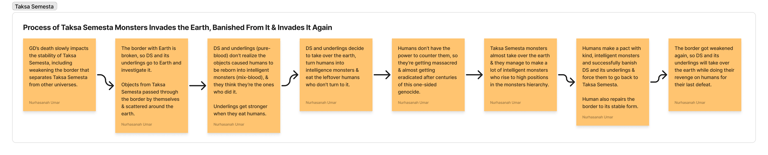
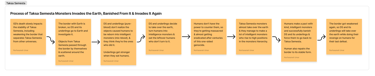
The intelligence monsters (monsters that are reborn from humans because of the Taksa Semesta's objects) became a crucial aspect since they were the ones who changed the trajectory of Taksa Semesta and the earth by making pacts with humans (those humans are called The Collaborators). That's why I made detailed explanations from two perspectives: the intelligence monsters' and humans'.


Humans Perspective
On the other side, humans were on the disadvantage side of the contract. They did get immersive powers, but the prices were too heavy and permanent, which was not suitable for the long run. But, since it's their only way to survive, they didn't have any choice.


When the war between humans and monsters was still going, The Collaborators became well-respected among the people, and this continued long after that since they're the ones who maintain universe borders that prevent the monsters from coming back.
But as time passed, people's respect turned into arrogance and ego. The normal human got blinded by fear of those ‘special powers’ and eradicated the descendants of The Collaborators who were still maintaining the balance of universe borders. This action bit them back in the long run


Kind / Intelligence Monsters' Perspective
From the monsters’ perspective, the contract was very advantageous for them since they could achieve their goals by only giving half of their power to the humans, and these pacts were passed down to the humans’ descendants—hitting two birds with one stone.
Instead of creating a monster universe purely with the 'law of the jungle,' where the strong beat the weak one, I incorporated consciousness, logic, political, and psychological aspects into it. So, the monsters have their own superpowers, moral compass, long history based on different ideologies, and political structures based on power and plutocracy.
The Earth and Taksa Semesta are separated by universe borders, so none of the monsters nor humans manage to get into each other’s universe for decades. That being said, there are lots of backstories that happen before the present time when the game starts. I'll break them down along with the writing process.
Taksa Semesta: Monsters
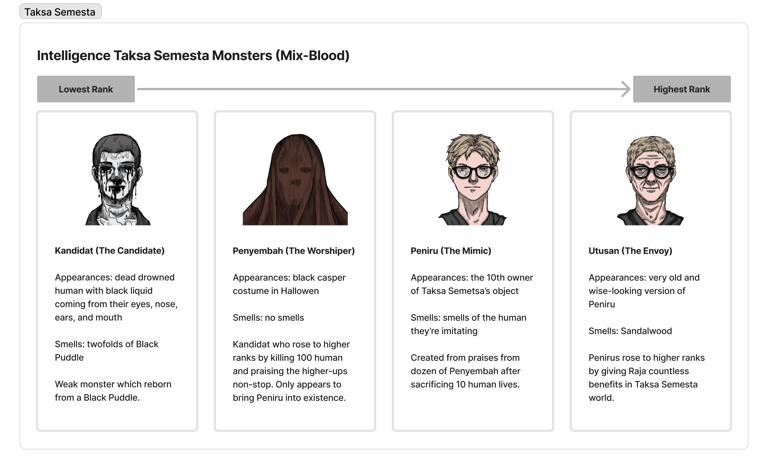
There are two kinds of monsters: monsters that are made by the Good Side/GS and Bad Side/BS → pure-blooded, and intelligent monsters which reborn from humans → mixed-blood. The intelligence monsters are inspired by Indonesian cultures and have human-like features. The illustration could be changed as long as it follows the character’s design intention.
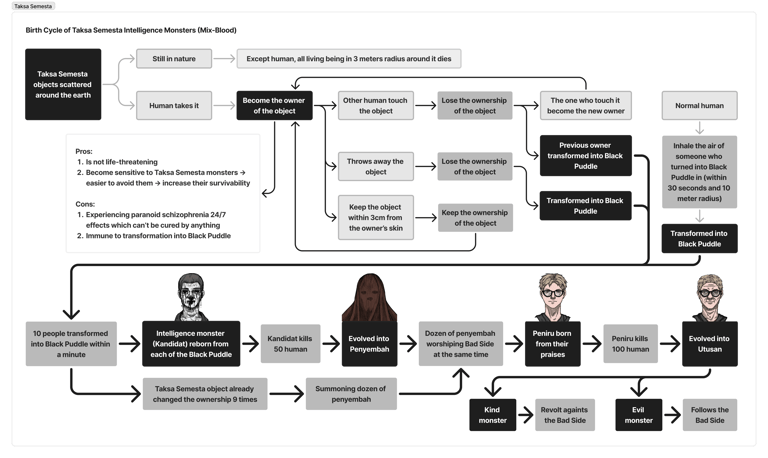
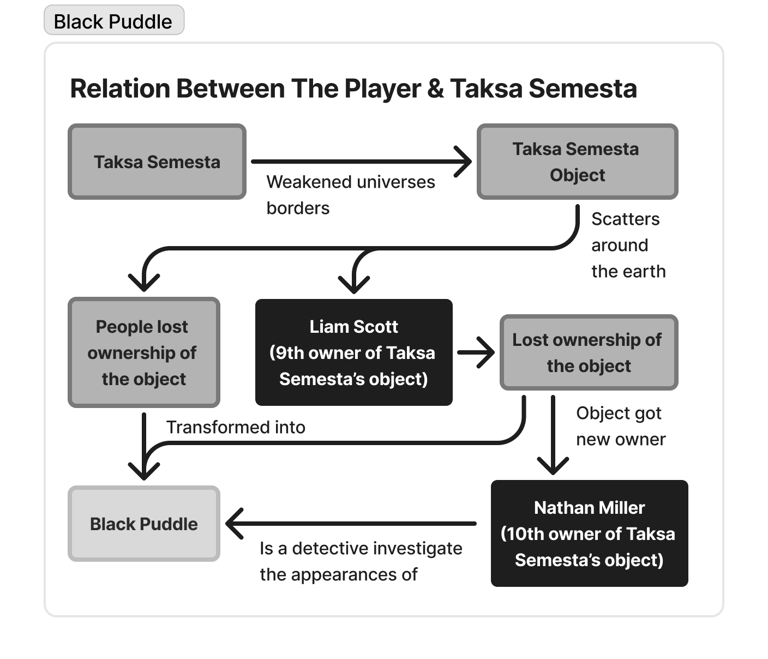
To make it easier to understand, I made a flowchart of how intelligent monsters are born. Black puddle is a pitch-black liquid with tar-like characteristics, but it has a pungent and horrendous smell that is different for each person who smells it.
The monsters' names and smells are inspired by Indonesia-related things, whilst the appearances are the rebirth stages of humans: humans die → buried underground → reborn in their prime age → become older and wiser.
Kandidat was inspired by Indonesian folklore named Joko Bodo, where the protagonist drowned his mom and himself to death because of his lack of knowledge, so it has characteristics of a dead, drowned human.
Penyembah was inspired by an Indonesian mystical creature named Pocong. It’s a ghost of someone who died with regret and haunted a certain place using their burial state—a body wrapped in a white fabric (kain kafan) and bound at its head, feet, and neck.
Peniru was inspired by an Indonesian belief named Jin Qorin. In short, it’s a doppleganger of someone who’s still alive, but they live in the supernatural world, which often intertwines with the human world.
Utusan was inspired by the traditional Indonesian social hierarchy, where the older you are, the more people will respect you because you have more life experiences. This tradition caused the opinions of the elders to be listened to more than those of the younger ones.
Player & NPCs Concept
Player Name: Nathan Miller
Age: 28 years old
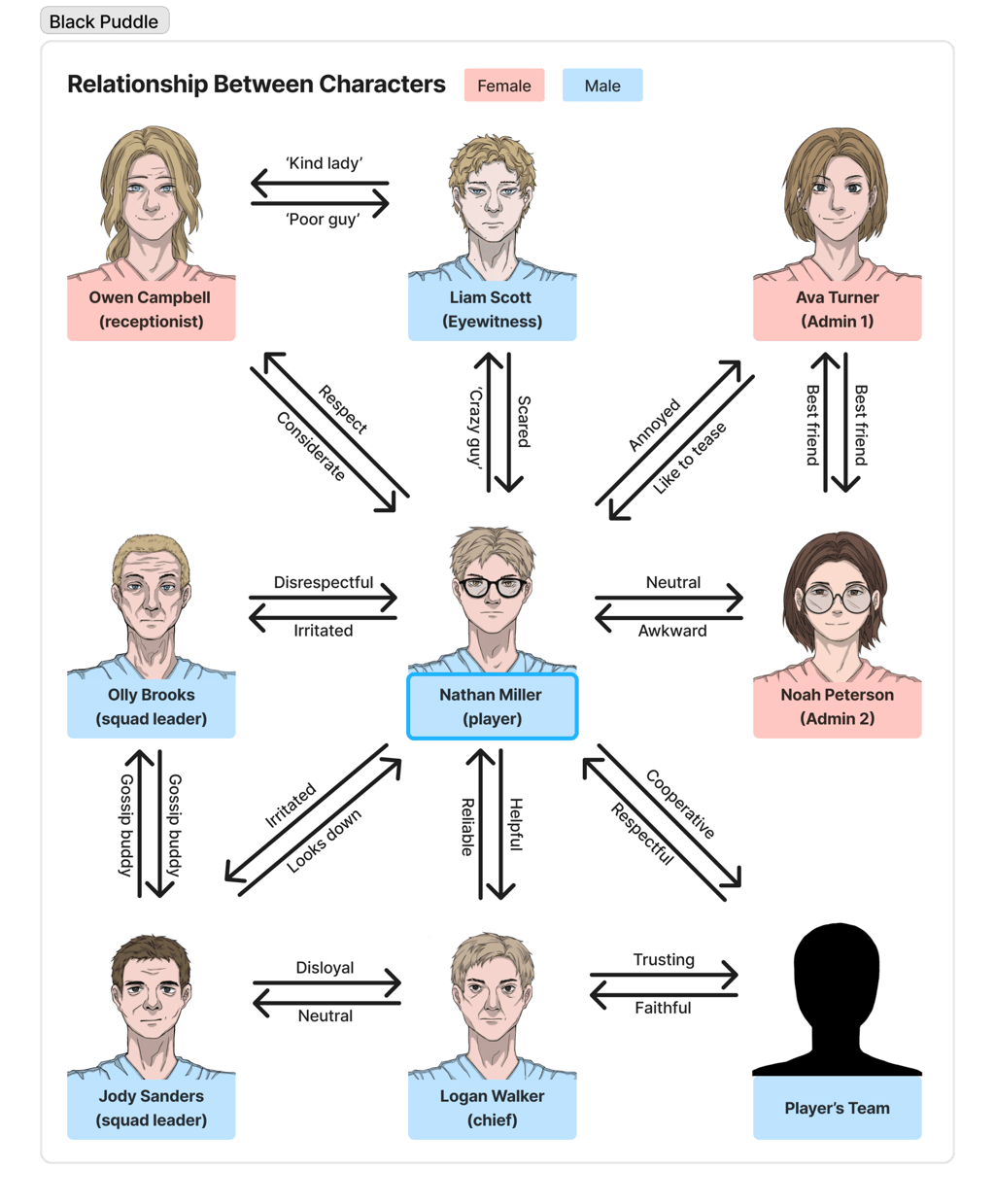
Nathan is a promising detective with high-analytic thinking and meticulousness. He doesn't have good social skills, but he's very good at handling strategic-related jobs behind the scenes, leading him to always handle reports and coordination from the police station for his team members on the field.
He's to the point, confrontational, and sarcastic, causing some people to openly hate him, especially the older men who are full of themselves.
Being overworked with handling behind-the-scenes jobs alone for a long time, causing him to be very efficient and hate people who can't do their work properly.
He's good at shooting and handling fights, but he prefers to avoid physical confrontation and do a more strategic approach before fighting.
He's wary and observant, always connecting the dots of clues inside his head, but he keeps his thoughts to himself and is not hasty to make a decision.
Eyewitness: Liam Scott
Age: 31 years old
Personality: cowardly, socially anxious, has anger issues
Liam is a failed film producer that drowns his depression and sorrow in weeds. After long self-isolation, he became socially anxious and paranoid. His cowardly personality mixed with unstable emotions, anger issues, and opium use makes him a ticking time bomb.
Receptionist: Owen Campbell
Age: 30 years old
Personality: friendly, caring, sensitive to other people’s emotions
Owen is a sensitive and caring mother figure which sometimes went overboard with her attentiveness. Despite that, she’s loved and respected by a lot of people because she didn’t discriminate and treats everyone with kindness.
Admin 1: Ava Turner
Age: 27 years old
Personality: expressive, easy to panic, people-pleasing,
Ava is the typical unorganized, expressive friend that troubles others because of his clumsiness. She has the habit of relying on others while pressuring them to help her. Not a fun person to be around because of her unconsciously manipulative tendencies.
Admin 2: Noah Peterson
Age: 28 years old
Personality: likes to tease people, comedic, relaxed
Noah is a relaxed person who's good at handling people. She doesn't take the spotlight, as she likes to be under the radar. She’s a loyal friend and concerned about others. She often helpss her other people, even if it’s annoying.
Officer 1: Olly Brooks
Age: 48 years old
Personality: grumpy old man, unloyal, self-centered
Olly is a grumpy old man that loathes others behind their backs. He likes to abuse his power to make his team work harder while he’s doing nothing. Everyone knows this, but they stay quiet because he’s the longest person who’s been working there.
Officer 2: Jody Sanders
Age: 38 years old
Personality: complains a lot, stubborn, gossiper
Jody is a stubborn person that complains a lot even if it’s only a small inconvenience. He doesn’t like being told what to do and loves to talk about other people behind their back. Typical annoying backstabber that lingers around people like a leech.
Chief: Redall Walker
Age: 46 years old
Personality: hard-working, responsible, logical
Logan is a hardworking, logical, and reliable chief, but the situation pressures him to make hard decisions that made some people hate him. He has the quality to rise to a higher position, but his idealism made him hard to adapt to the political aspect of it.
Story Progression
Since this project was a detective genre, the process of uncovering the truth and all of the backstories itself is an important process. Meaning, triggering the curiosity of the player so they're eager to uncover everything in the full game is a must.
So, in this Intro to Act 1, the story focused on introducing the player and his investigation that's directly related to Taksa Semesta: the appearances of unknown black puddles that have different smells for different people, which kill every plant and animal that touches them.
I aimed to give a lingering feeling of surprise and confusion, like ‘Huh? What is that? How?’ In the story. Sudden changes of ambience and tension became a crucial aspect.
Areas Scope
Every part of the story must be feasible to be implemented in the level design. And, since I was the one who made the level, it became easier for me to decide the area scope based on my ability at that time.
I got a lot of police station pictures while I was researching for the level design references, and the medium-size buildings checked all the lists that I needed. I also focused on making everything happen inside the building, so it didn't burden me to make complex levels considering it was my first UE5 project.

Since the full game will be full of uncovering Taksa Semesta’s backstories, aka. flashbacks, I didn't want to ruin the fun by showing there'll be flashbacks right inside Intro to Act 1. That was why I designed the first story to fully happen in the present time.
To accentuate the terror of Taksa Semesta, I made the player go through a series of missions that showed the anomalies of black puddles, how close the player was to other NPCs, how kind and helpful the player was, etc., before demolishing all those ‘safe’ feelings when people turned into black puddles and monsters were reborn from that.
This way, the player experienced everything firsthand, intensified the tension, and aligned with the boundaries of no ‘flashback’.
Game Beats V1
Mission Flow V1
Despite the detective genre often being associated with ‘puzzle’-like missions, I decided to keep that experience for the full game.
So, in this Intro to Act 1, the first mission design focused on introducing the current situation of the player and the world, giving them reasons and motivations when entering the full game.
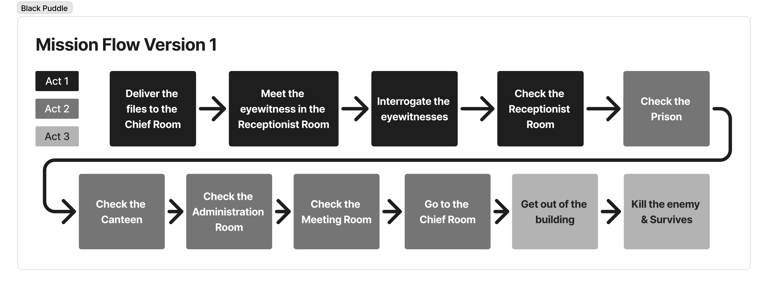
The missions were made to look like mundane things to do as a detective: deliver documents, help people, interrogate, etc., to establish the integrity of the player’s character and how he takes his profession seriously while having a kind personality.
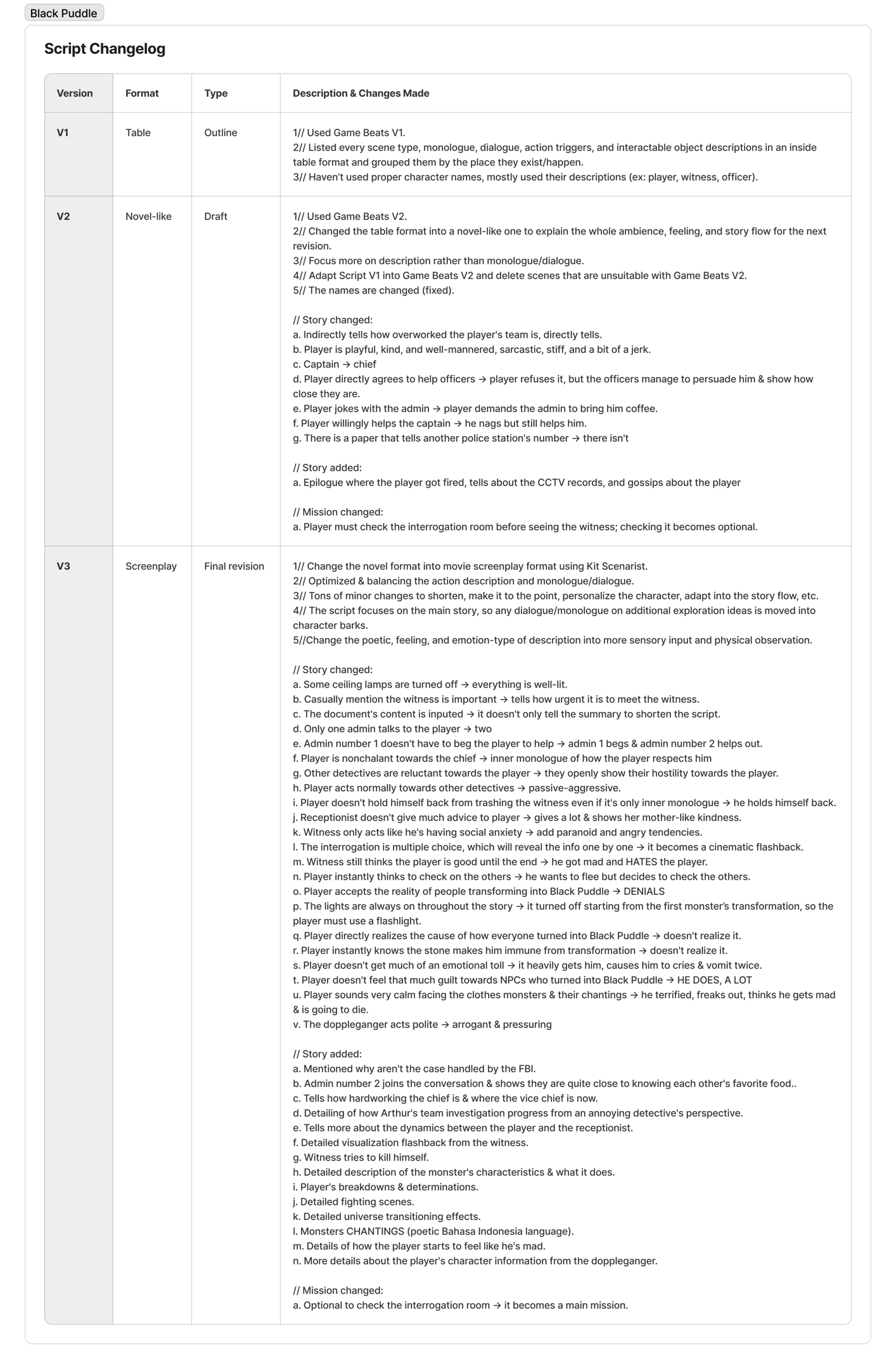
Screenwriting v1
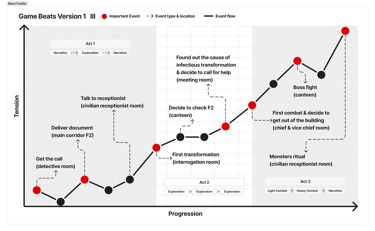
The first game was made to focus on uncovering mystery, so the player deduces reasons and immediately knows the reason why all people inside the building turned into black puddles.
But, when creating the script, I realized the story progression was too fast and there was too much information dumped in one go. It didn't let the player deeply feel the psychological effect of Taksa Semesta—which was one of the main goals from this part of the story.
And, when creating the blockout, there were not enough game-ready assets to make the prison area, where the player will inspect it to know whether the prisoners turned into black puddles or not. So, the story flow needed to adapt with the asset's availability.
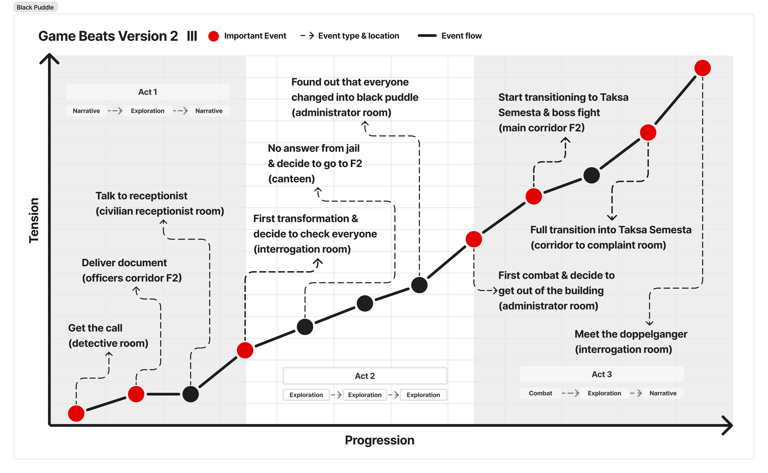
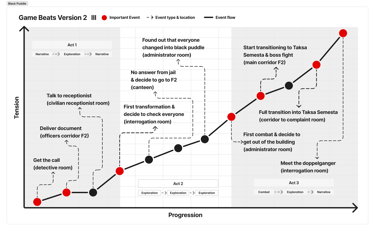
I realized providing information in gradual stages was essential to control the player’s curiosity and keep the story interesting, especially in a detective genre like this. Too much information will only distract the focus.
That was why this second game beat was focused on slowing down the story, reducing the amount of information given to the player, and adapting to the level design progression. So, the story progression wasn’t as steep as the previous one, and it gave the player time to process everything logically, letting the eerie feeling bleed into the player’s mind.
These changes led to more psychological and engaging gameplay, so this decision was ideal to enhance the dark narrative aspect of Taksa Semesta.
Game Beats V2
Mission Flow V2
There weren't a lot of changes in the mission design since the intention to focus on uncovering the narrative and keeping the puzzle-like mission for the full game stayed the same.
Yet, some of the reasons why the missions happened changed based on the updated game beats. In the first version, the player must go out from the building to tell other people the reasons why people turned into black puddles (focused on detective integrity).
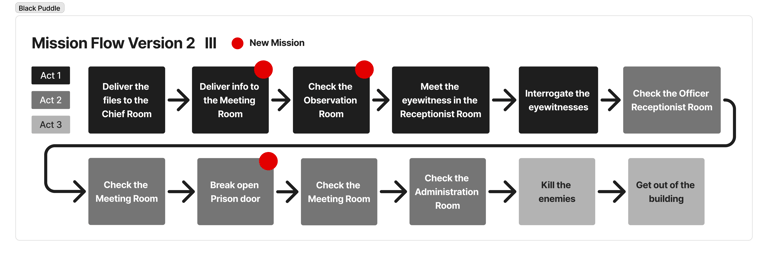
But, in this second version, the player must go out so he doesn’t get killed by the monster (survival focused), which was more natural and reasonable decision if someone is in life-or-death situation. Overall, the mission's design was similar, and the changes focused more on where the event happened.
Screenwriting v2
This second screenplay has a slower story progression and less spiked tension, it gave more time for the player to process all the information, so the narrative didn’t feel rushed nor info-dumping.
The way to build tension also got changed. The previous version was focused to show everything that happened in front of the player. This version elevated the mystery and unseen terror aspects, so the player won’t be able to see and uncover everything in one go.
The player won’t be able to check on the prisoners, but he could smell the black puddle from outside of their room, letting the imagination do the rest. Instead of immediately knowing the reasons people turned into black puddles, the player won’t know about it, keeping them in a sense of confusion. And other things.
In short, this second iteration enhanced the psychological aspect of the story that intensified the gameplay’s tension.
Visual References
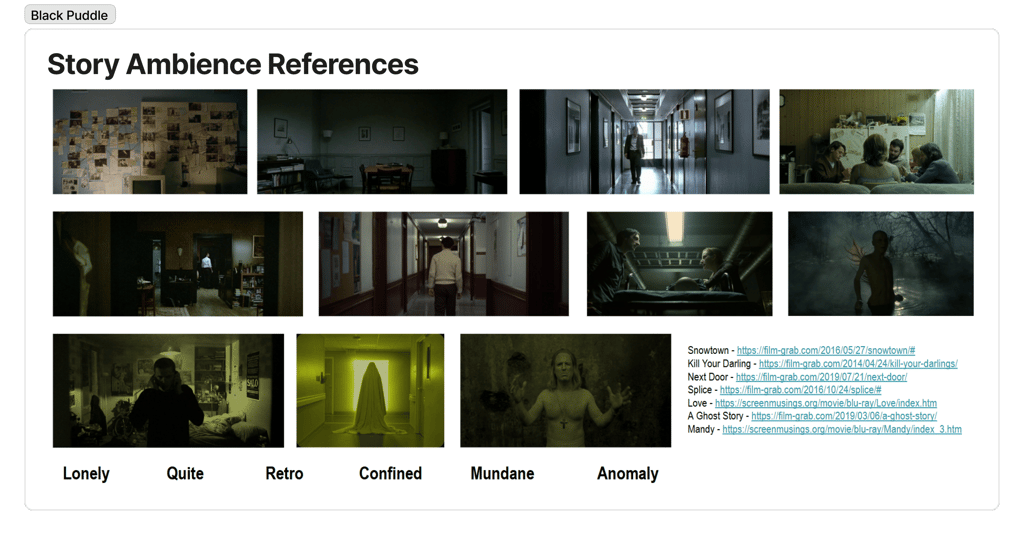
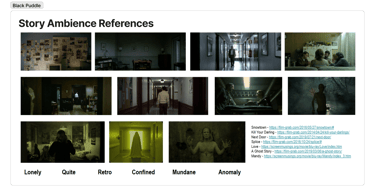
I created a visual concept as a baseline for the 3D environment. The ambience in the first half of the story feels mundane since the collision with Taksa Semesta hasn't happened.
When it does, the environment stays the same (except for monsters and black puddles appearing), but the lighting changes drastically to increase tension and the eeriness of it.
The keywords are the main feelings that must be conveyed through the level design and environment art later on.
Script & Barks
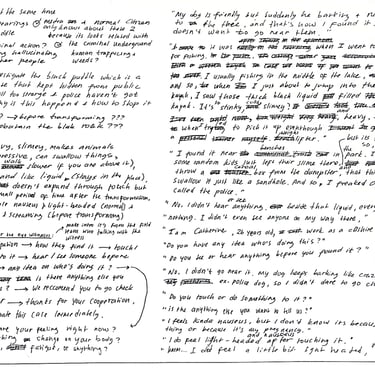
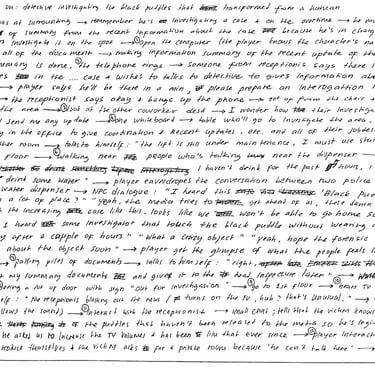
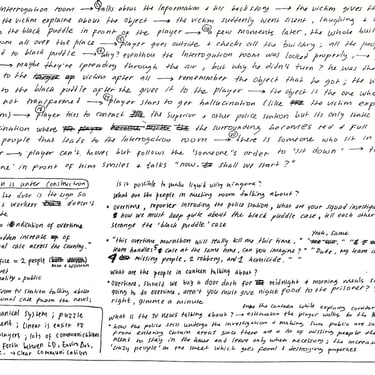
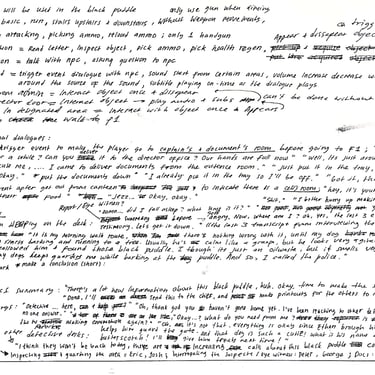
During the scriptwriting process, I did tons of manual writing to brainstorm and refine the ideas. It helped me to get better output since I already explored different possibilities before digitalizing the ideas.
Pardon the unrelated scribbles on the writing pics, as I made them in my collective gamedev sketchbook.
Implement Narrative Into Gameplay
I didn't have enough blueprint skill to implement every narrative directly in UE5, so I did the method that I used on my other four solo projects: video editing in DaVinci Resolve. I recorded the art pass gameplay (with interactable items and enemies placeholder) inside UE5 using OBS Studio and did post-process editing inside DaVinci Resolve to add subtitles, cutscenes, and audios. This resulted in a 6-minute gameplay prototype (160% speed) with implemented narrative.


Playthrough (Art pass)
This gameplay prototype shows how all game writing aspects got implemented into the whole gamedev pipeline. It also included scenes from the screenplay (the formatting was already adapted for gameplay usage) as cutscenes/another gameplay reference.
You can see the whole level design documentation to make this playthrough in here.
Things I’ve Learned
All stories and narrative ideas will be an important baseline for the further game development process, so make sure it's feasible and achievable by the team's skills. Be innovative yet grounded all the time.
Making a story within a theme that we know well works like a wonder. It cuts off the research time and can automatically deepen the narrative. But, stay grounded. Keep the curiosity alive, ego can kill ideas.
Combining real-life cultural aspects is both interesting and tricky. Make sure to deliver the information respectfully without pointing fingers or trashing them to avoid future problems.
Deepening the story and narrative through exploration and collecting indirect information is gold. Those naturally build the tension and are more interesting compared to laying everything on golden plates.
Slamming a completely opposite story & narrative of what the player’s accustomed to caused it to become memorable. Use it wisely to accentuate the importance of certain events.
Planting doubt, such as “There’s no way that happened,” in the player’s mind is often necessary to deepen the tension of the story, especially if the setting heavily leans towards logical thinking.
© 2025 Nurhasanah Umar. All rights reserved.