

GW: Don't Go Back
Mystery, Suspense, Psychological, Drama

Notes:
This game writing project was made streamlined as the level design of Don't Go Back was made, so the playtesting phase on the level design directly affects the workflow and the game writing progress.


Overall View
In 2024, I joined Blocktober in X (formerly known as Twitter) for my level design portfolio. Because my level design tends to be narrative-heavy, a thought came into my mind: “Why don’t I make the story to be used for the level? It’s also good for my writing portfolio." And so, I did it.
Because Blocktober was an event held in the entire month of October, the story concept should be within topics which I had enough knowledge of to shorten the research duration and maximize the writing period.
Thankfully, I had researched various things to conceptualize Taksa Semesta (a monster universe in Black Puddle and Future Siren) and things about cult abuses, so those ideas mixed in my head and formed a new concept: a kid must escape from an abandoned satanic church while being chased by human trafficking abductors.
To fill the gap between the escape attempts, I designed exploration and discovery gameplay which led the player to uncover the corrupt history laid beneath this old church—and the player must escape through the underground area, which was used as a children's sacrifice ritual place.
Satanic Church: irl Inspirations
The story happened in the modern days, where everything looks normal, but there were illegal things happening beneath the radar: abducting people from low-income countries and selling them in human trafficking routes. And the player is a kid—which caused the matter to become morally worse.
Since IRL it was a sensitive topic with countless victims, I didn't want to create a story that disregarded them. Making it feel grounded and realistic but still within fictional boundaries became a principle when conceptualizing the worldbuilding. So, I researched the experiences of people who have been dealing with cults, human trafficking, and the Salem Witch trial. Those data then used as the base of the story concepts.

Nessie Judge - KESADISAN SEKTE SETAN INDONESIA ft. MONGOL | #NERROR
Inspiration for: helpful customs between the cult society, different kinds of sacrifices in the ritual & hierarchy between members.

BuzzFeed Unsolved Network - The Horrifying Abuse Within Children Of God
Inspiration for: restricted environment for apprentices, brainwash them so they have no right to say ‘no’ & corrupt cult members.
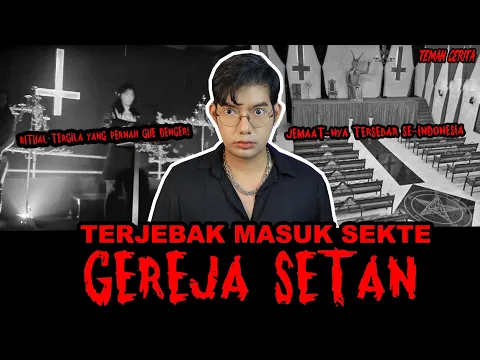
Hirotada Radifan - MENJADI PENGIKUT GEREJA SETAN
Inspiration for: new apprentices must serve the cult members until they bear babies to be sacrificed for.

Soft White Underbelly - Sex Trafficking Victim interview-Clover
Inspiration for: underage kids become victims and can’t do anything because older people are dominating them.

Bailey Sarian - Witches in Salem or Something Much Darker? The Salem Witch Trials - Mystery & Makeup| Bailey Sarian
Inspiration for: snowball effect of normal civilians & government fears on the cultist members that caused ‘witch trials’ 1 & 2 and all of their aftermath.
Satanic Church: Backstories
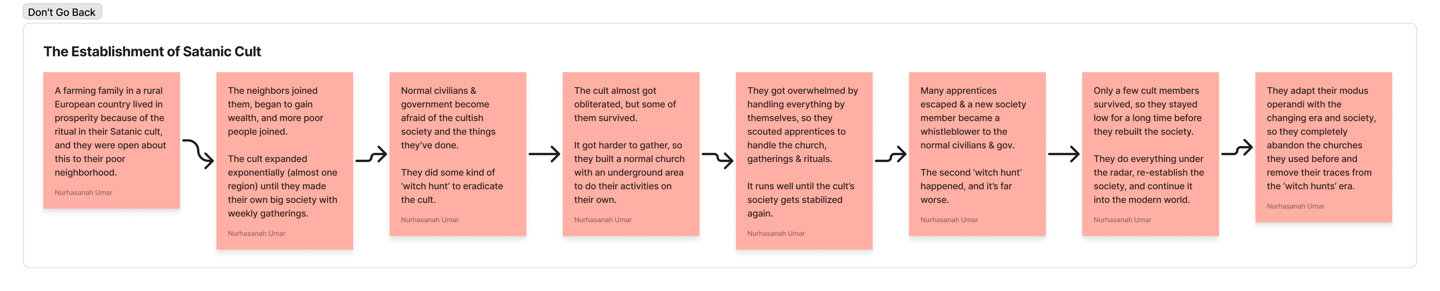
Long History of the Satanic Cult
Establishing how the cult was formed became the key foundation to the whole satanic community. Since the story needs to feel grounded, the causalities of how it was built were inspired by how some communities were naturally created IRL: well-off people helping less fortunate ones → people bond and help each other inside the 'community' → all members become more prosperous → new less fortunate members join the 'community' and get helped → repetitive cycle.
This created a solid connection between the members since each one of them felt like a family who were helped in their darkest times. That was why the cult managed to survive through the eradication attempts from the normal citizens and is still standing until the present time under the radar.
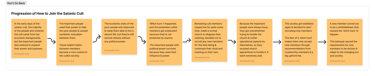
Recruiting Process: Normal Cult Members
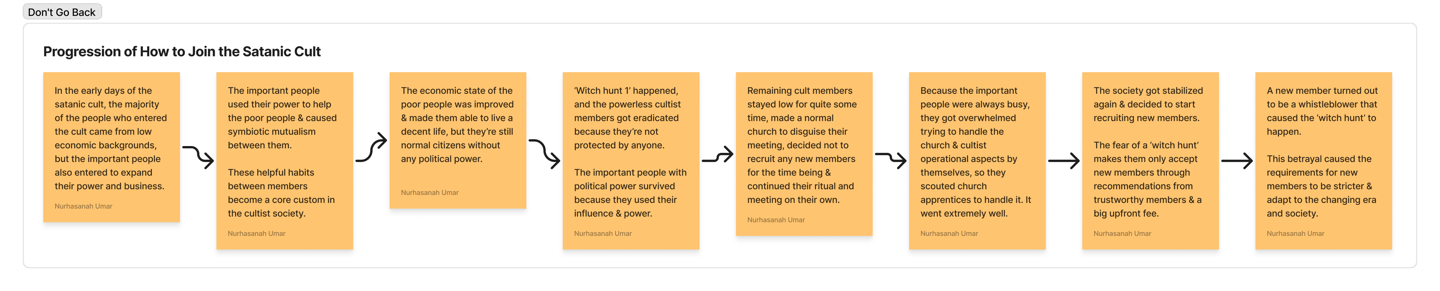
From the highs and lows of the cult's establishment history, there were some changes in how the cult accepted members. In the early days, the cult gained followers by implementing mutual benefits between high-profile members and low-profile members. But after the series of 'witch hunts,' the joining criteria changed so it favored the high-profile potential members—prioritizing qualities over quantities.
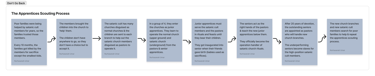
Recruiting Process: Operational Handler/The Apprentices
As the community got bigger and more people needed to be facilitated in all of the rituals, the need to find people who'd fully take care of the community became unavoidable. That was why they started to scout kids as apprentices who'd be raised as the 'servants' of the community. They also had lower ranks compared to the normal cult members—showing the corrupted moral that “righteousness can only be obtained by the riches.”
Unlike the normal cult members who always profited, the apprentices became the victims who can't fight back or stop this cycle because the root problems (higher-ups in the cult society) are out of their reach, so it's become a repetitive cycle of hell.

Story Progression
With this kind of story that demands the player to be empathetic with the characters, the introduction phase that reveals the backstories and makes the player eager to reveal the hidden truth becomes crucial. So, I made this project as an Intro to Act 1 before the full game happened.
I wanted to make the story feel grounded to accentuate the child abuses and spread awareness of it, so the narrative theme revolves around despair, terror, false hope, and trapped feelings.
Since it must give the impression of ‘it could happen to anyone’, events that happened should be realistically possible IRL. So, there won't be any flashback scenes in the narrative progression. The player would only know things happened inside this place from the clues that were left, and their own imagination handled the rest.
Inspiration From Musics
For the core story itself, it has been decided since the early days in Blocktober, but as the scriptwriting process is going through, there are some musics that greatly inspired the ambience and characters feelings.

Nathan Wagner - Angels vs Demons (Piano Version)
Inspiration for: kids who became ritual sacrifices helps the player escape through the underground tunnel.

Rituals - Jiovanni Daniel
Inspiration for: tough survival process of the player to escape from the abductors & the bobby traps in the underground area.
NF - Intro III
Inspiration for: player has multiple personalities, and the psycho one becomes dominant after one of the abductor almost kills him.

Sleeping At Last - "Eight"
Inspiration for: the realization where the player must fight back the abductors in order to survive.

Citizen Soldier - Words That Don't Exist
Inspiration for: apprentices desperation to escape from the satanic church, either die or alive.
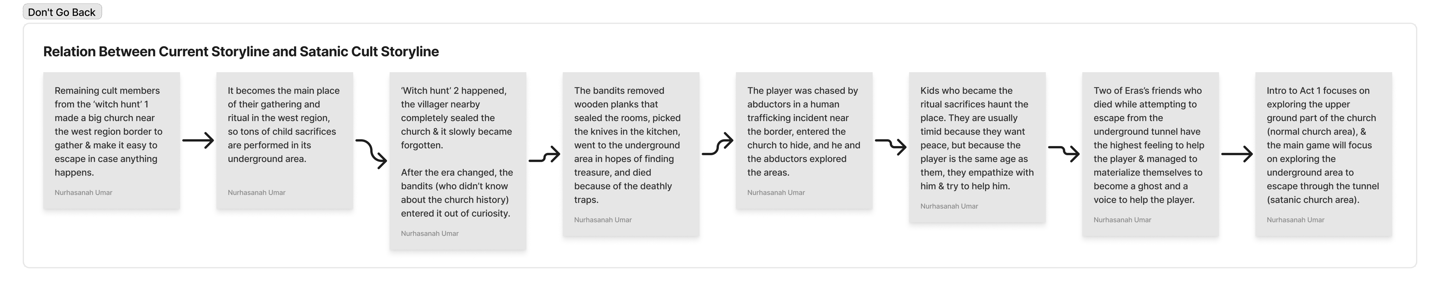
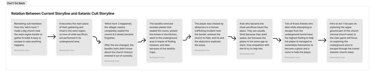
I've made the timeline to show the relevance between the cult history, what happened near the time period of the game, and when the player is playing the game, so everything is coherent.
Player & NPC Concept
Player Name: Aster
Age: 13 years
Aster is an intelligent kid from a rural town. He doesn’t go to school to help her parents with their field, so he’s very close to his family. A rough childhood leads him to mature faster. He had been kidnapped once, and it traumatized him until he got dissociative identity disorder (DID) and memory loss, but his family hid it from him.
Being tricked by other people trains him to be calculative and cautious of new people, so he’s fast at catching people’s emotions.
Working in the field trained his body and stamina, so he’s more resilient than his peers. But he has asthma and low blood pressure.
He isn’t the leader of his peers, but he’s the one who makes sure everyone is safe; he’ll only take charge if the situation forces him to.
His other personality is unempathetic and solely focused on surviving because it was created to protect his past self when he was kidnapped and helpless.


Muscular Abductor: Paul
Age: 36 years
Personality: hot-headed, strict, dominant, abusive
Paul is a tall-built man who forces others to do what he wants and take charges through violence. He only hears advice from people he thinks are capable and trashes the other. But he’s very capable in the human trafficking world, causing him to have strong international connections.
Knives Abductor: Gibbs
Age: 34 years
Personality: quick thinker, loyal, easygoing, sociable
Gibbs is a free-spirited man; he only joins Paul’s group because Jay asked him to. As a former circus performer, he’s agile and incredibly good with knives. A bit docile and doesn’t care that much about everything, but will kill someone if they mess up with people he holds close.
Gun Abductor: Hans
Age: 30 years
Personality: calm, efficient, logical, wary
Hans is a quiet man who talks only when he needs to. He’s a bit of a perfectionist and too good at everything he does. He’s the right hand of Paul and the one who directs the group from the shadows without everyone noticing. He cares about his friends but at a distance, keeping everything professional.
Drunk Abductor: Jay
Age: 32 years
Personality: stupid, stoneheaded, sharp-witted, honest
Jay is a clown of the group who talks with no filter. When he’s drunk, he talks all over the place, is dumber, and can’t fight well. But if he’s sober, he has sharp instincts and reflexes that make him on par with Gibbs in close combat. He doesn’t like being told what to do, but he’ll comply.
Areas Scope
The main place the story happened was inside an old gothic church. This place looked completely normal to disguise the truth that it was a church for a satanic cult that did amoral things for their rituals.
To accommodate this need, the church was designed to have two areas: the upper ground for a normal church (as undercover) which was used for ordinary church activities, and the underground area for the satanic cult that could only be entered through the hidden passage. And so, in this Intro to Act 1, the story fully happened on the upper ground of the church. The full game will be in the underground area.
In the earliest days until mid-Blocktober, the level design was fixated with two game mechanic ideas: “There are some rooms that can only be entered once, so the player must investigate the areas thoroughly before they close,” and “It has a certain place to hide, like a closet in Outlast.”
So, the narrative adapted to this idea. The first version of game beats and mission design was created to utilize it while progressing through the story.

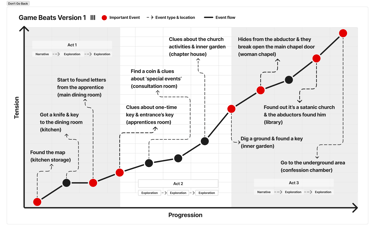
This Intro to Act 1 acted to build tension and ambience of the place, so the story led the player to explore the upper area of the church. The player would find clues of what this church actually was and what the satanic cult did to the children who became apprentices here.
The clue discoveries inside this first game beats was straightforward, so the player doesn’t need to connect the dots since all of them immediately connected with each other.
The story also focused on making the player hide since facing the abductors head-on was too risky. But eventually, they would face each other near the peak of the story progression—forcing the player to escape through the underground area to get away from them, intensifying the tension.
Game Beats V1
Mission Flow V1
The missions were designed to revolve around the ‘one-time usage room’, ‘hiding place’, and ‘exploration to find clues’, so the missions themselves looked easy. The difficulties emerged in the process of doing the missions, just like side missions.

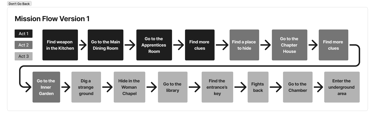
Of course the kind of ‘side missions’ they would do were adapted to the conditions of the environment and the story progression: solving puzzle to open locked crate, navigating between old props without being notice, find an openable door to go to a certain areas, etc.
This created anticipations, intensified the tension, and kept the player’s focus—unconsciously steering them to be psychologically and emotionally present throughout the gameplay.
STORY IMPLEMENTATION INTO THE BLOCKOUT
I didn't create the full screenplay right away. Instead, I directly implemented the story into the blockout process to know whether it works well with the level or not. Since it was developed based on the first game beats and mission design, it was full of suspense and designed to leave tracks of gore throughout the discovery phases. The ‘hiding place’ and ‘one-time usage room’ also created interesting variety in the story.
But problems happened when I implemented it into the blockout and playtested them. Those mechanics weren’t achievable with my skills, so I couldn’t measure whether the gameplay based on the story that I’ve made was fun to play or not.
Aside from that, it made me realize the suspense and gore feelings it created didn’t fit to be placed in this area since it gave an obvious hint there were torture devices around in this place. It revealed the fun and surprise that should’ve only been revealed in the underground area.
And so, the next story iteration must be adapted to my skill limitations in creating gameplay mechanics and adjust the story progression so it won’t spoil what the player found in the underground area.
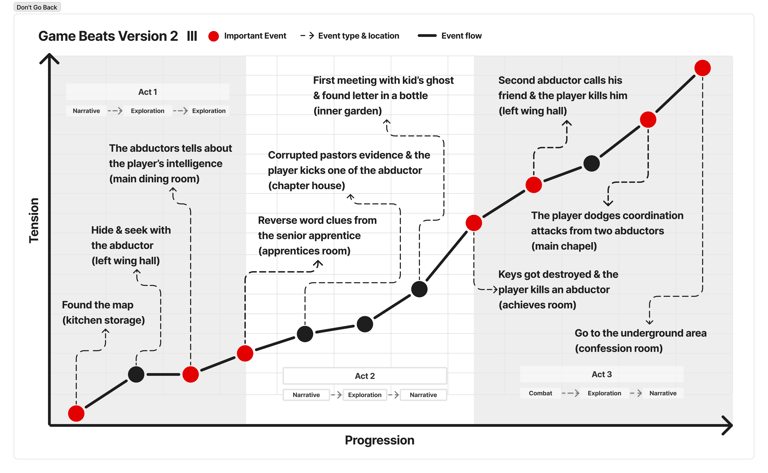
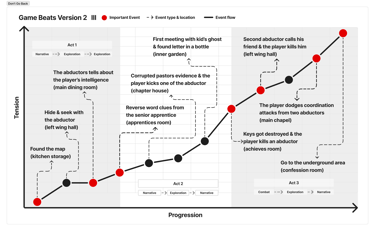
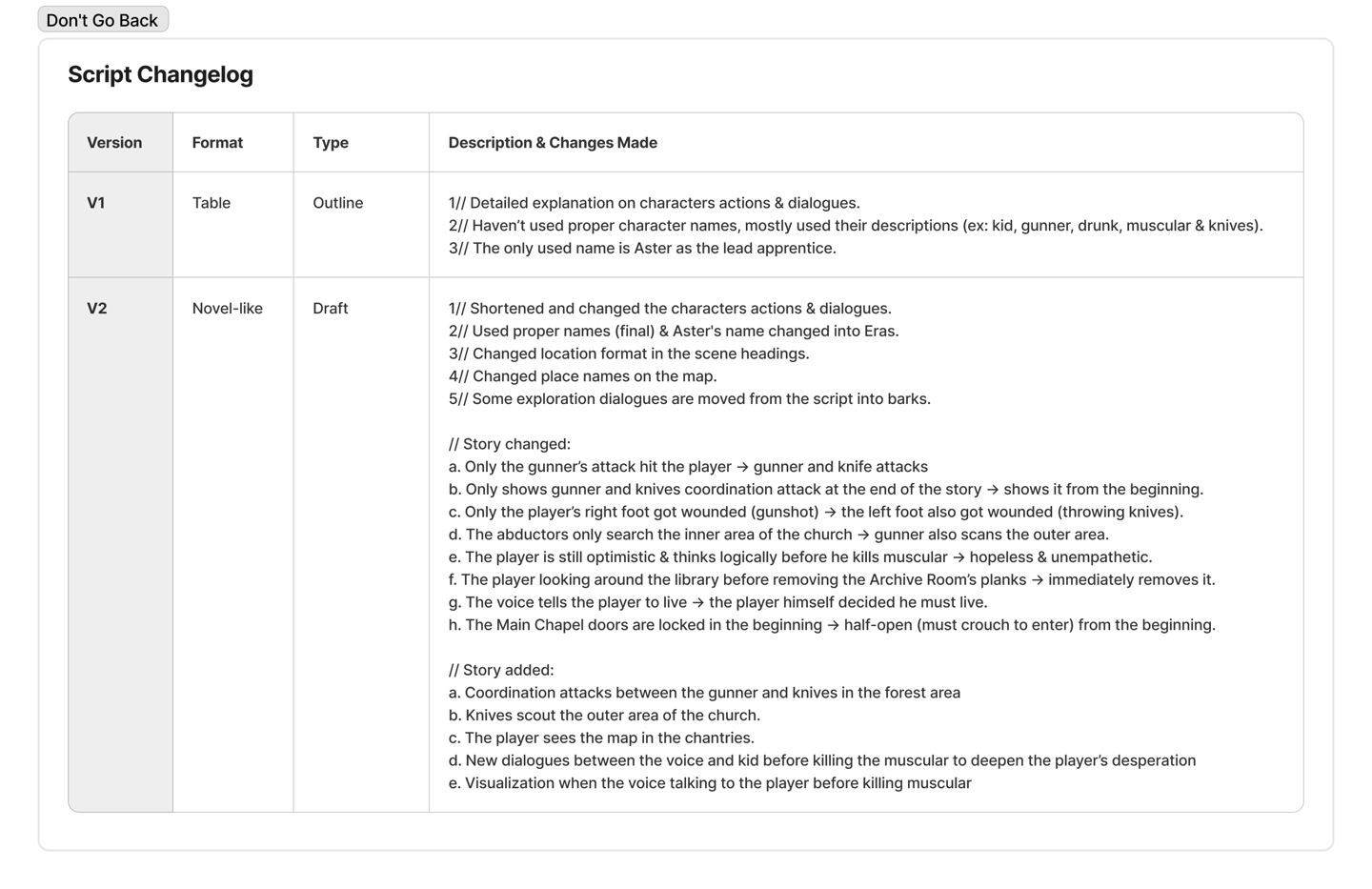
There were plenty of revisions based on the analysis of the previous script, and it created a new story flow and discoveries. The narrative and exploration became more thorough while keeping the surprise aspects and feasibility to be implemented in the level design process.
In this new beats, the story progression also got changed, so it had significant character development. The player didn't only hide, but he would fight back to stay alive—even if it meant killing someone.
A new key aspect also got added: ghosts of the sacrificed children that would help the player to escape. It was still aligned with the intention of creating the story to feel realistic, since there were paranormal occurrences in wrongfully used places IRL, so it was okay.
Game Beats V2
Mission Flow V2
The analysis of the previous screenplay and the level design progression—which greatly broadened the amount and types of explorable areas—caused major changes in the mission design that affected the whole narrative.
Besides leading the player to explore more areas, the missions also made them analyze things and be more alert to the surroundings since the abductors became more active to find the player.

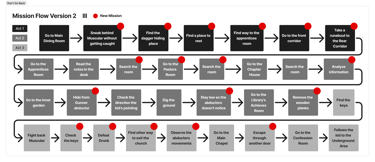
It amplified the player's engagement with the environment, expanded the narrative discoveries, and increased the tension while making sure everything was aligned with the core intention of the story.
And, since it has an escaping theme, there would be ‘hide from the abductors’ events that use crouching and holding breath mechanics just like Until Dawn.
Screenwriting
From simulating the new concepts into the new blockout, I knew the narrative and gameplay experience were finally solid enough to be made into a story script. So, the screenplay was made based on the game beats v2 and missions flow v2.
All those detailed concepts made the screenwriting process easier, and it let me focus on optimizing the writing style to be more engaging and evoke emotions. There were lots of adjustments related to the character's concept so it aligned with the new story progression.
I also added an opening scene in a forest near the church where the player runs away while being chased by the abductors, and they inflict wounds on him—immediately setting up the tension and giving a general view of the dynamics between characters.
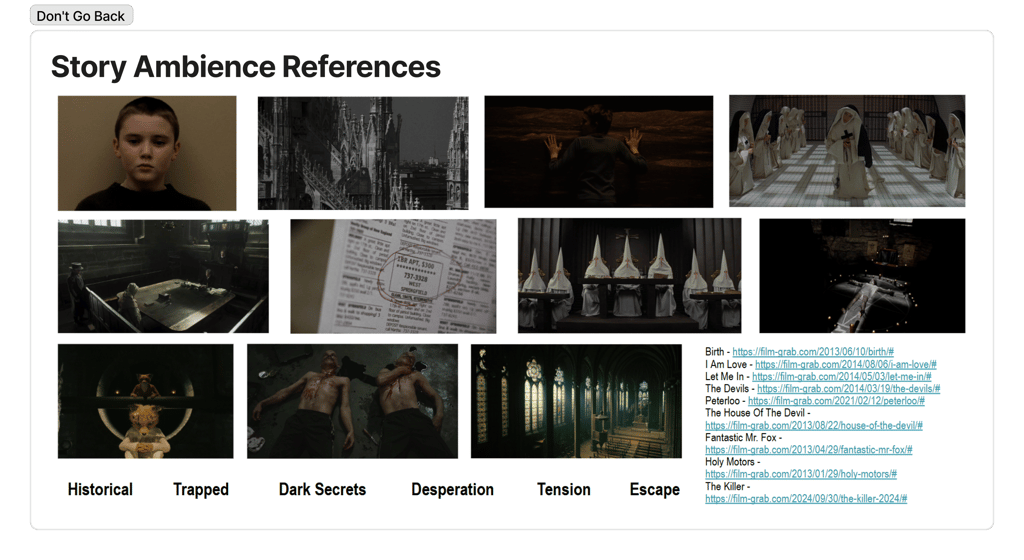
VISUAL references
While the majority of the ambience depends on the old church environment design, all other aspects (3D asset type, sound design, voiceover, lighting, cinematics, level design, etc.) should convey this type of tone to enhance the mood.
Since the tension progression inside the story was mainly psychological and suspenseful, dramatic lighting and dark/haunting ambience must be balanced so it doesn't overwhelm the player.
Do refer to real-life cultist color themes to make it more mentally daunting when the player realizes the correlation.
Script & Barks
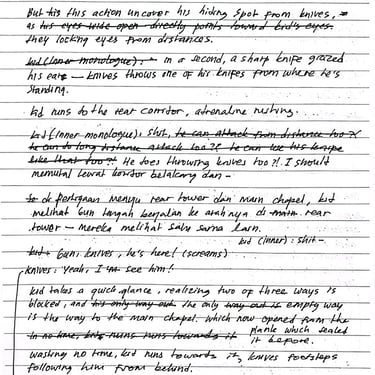
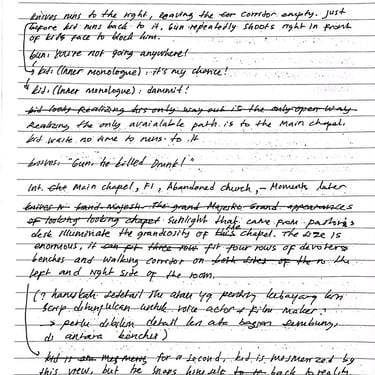
During the scriptwriting process, I did tons of manual writing to brainstorm and refine the ideas. It helped me to get better output since I already explored different possibilities before digitalizing the ideas.
Pardon the unrelated scribbles on the writing pics, as I made them in my collective gamedev sketchbook.
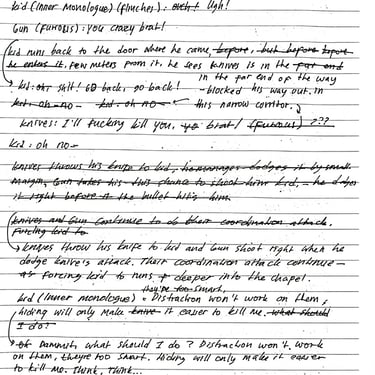

Implement Narrative Into Gameplay
I didn't have enough blueprint skill to implement every narrative directly in UE5, so I did the method that I used on my other four solo projects: video editing in DaVinci Resolve. I recorded the blockout gameplay (with interactable items and animated NPC spline) inside UE5 using OBS Studio and did post-process editing inside DaVinci Resolve to add subtitles, cutscenes, and audios. This resulted in a 8-minute gameplay prototype (160% speed) with implemented narrative.


Playthrough (Blockout)
This gameplay prototype shows how all game writing aspects got implemented into the whole gamedev pipeline. It also included scenes from the screenplay (the formatting was already adapted for gameplay usage) as cutscenes/another gameplay reference.
You can see the whole level design documentation to make this playthrough in here.
Things I’ve Learned
Getting inspired by real-life things is normal, but some aspects (culture, history, religion, etc.) tend to have more sensitive boundaries. To avoid problems in the future, mix fictional ideas inside it so the player subconsciously understands the story is fictional. So, it’s okay to tweak things here and there.
Sometimes how the story is going is heavily affected by the environment that has been designed from the start, so the writing must adapt with it. Make sure to deeply understand other teams’ works (if you’re not working solo) to avoid unnecessary revisions because of misunderstanding.
The story build-up before the peak tension must be reasonable. Minimize loopholes and sudden progression that made the player harder to catch up on what’s happening. Treat the story like a roller coaster, not a teleport machine.
Problems that hinder the players from getting what they want are our best friends. It keeps the story and tension going, but don’t overuse it. Give them breathing time and rewards so the game becomes fun and enjoyable rather than a marathon of punishment.
Sometimes, the project timeline prohibits you from doing further improvement to make everything perfect—that’s totally normal. Adapt to it and optimize the time. That way, even though the story won’t become a magnum opus, we can deliver the best output within our capacity.
Compromising ideas and changing them so they’ll become more feasible within the team’s skill set and current situation are crucial. Understand the development process, put down the ego, and focus on adapting the ideas compared to becoming a blockhead that insisted on something too idealistic & unachievable.
© 2025 Nurhasanah Umar. All rights reserved.