
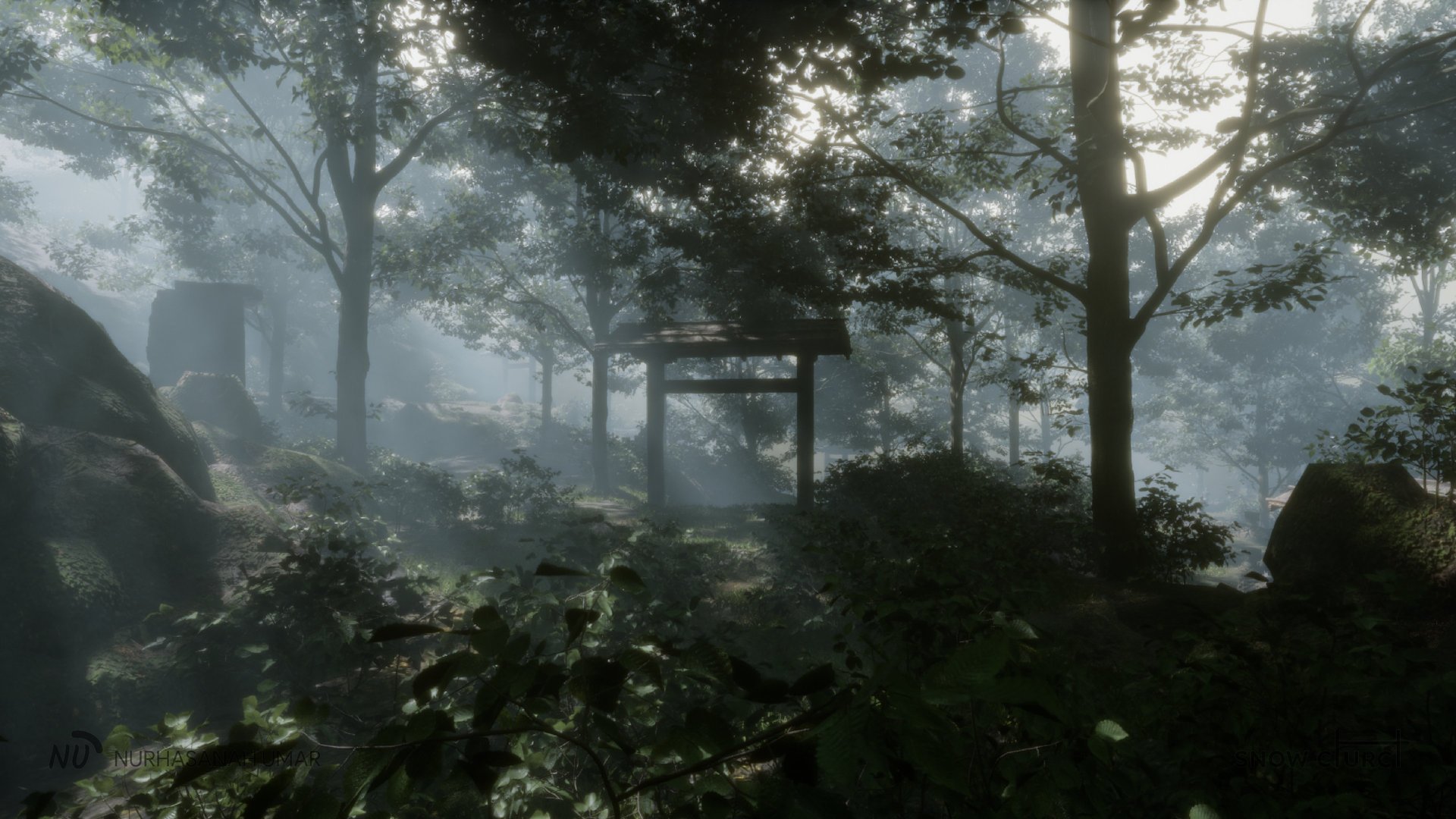
GW: Snow Church
Detective, Story-Rich, Suspense, Drama
Notes:
This game writing project was made streamlined as the level design of Snow Church was made, so the playtesting phase on the level design directly affects the workflow and the game writing progress.


It's a fan project spin-off based on the Control game made by Remedy Entertainment. While the player character used an original character, Jesse & Dylan were used as important characters in the story that'll become the main plot in the game.
Overall view
I understood game companies need game writers to make a continuation from their published game. So, to demonstrate I can fulfill this need, I made a fan project multiverse of Control by Remedy Entertainment. I realized multiverses are how different things can be, but there was always a red string that connects everything. I also noticed the detective game’s protagonist tended to be young, mentally stable, and logical all the time. So, it’ll be interesting if I make the polar opposite of them.
Specifically, a grandpa who lost all of his blood relatives and tries to save the childhood best friends—Jesse and Dylan—of his deceased grandkid.
Revisiting the past and being trapped in guilt became key themes in the story, so I gave the player's character the ability to vividly remember the past (photographic memory) and mental illnesses that force the character to keep reliving the grief.
So the story flow will look like this: present → past → present → past → present.
It was challenging to balance the multiverse aspect and the original Control game from Remedy Entertainment. To differentiate it (besides creating original characters, backstories, FBC positions, etc.) I also made a new kind of Astral monster, which is inspired by Ahti. It has a human form that differs for each person who looks at it, and it does psychological attacks rather than physical ones. It is also the first creature that roams freely without being noticed by the FBC.
In short, the FBC became an evil organization. The player is a PTSD and schizophrenic grandfather with photographic memories. He is an ex-cold case detective, and he tries to save Jesse and Dylan from the FBC. And there’ll be new astral monsters that only appear in this multiverse.
Analyze the Prior Control-related Games
From what I've learned from previous projects (Black Puddle & Future Siren), after the initial ideation process, we MUST do deep research to decide the project's direction and not get lost in the development process.
So, I started the research from the original game, which I'll make the multiverse from: Control by Remedy Entertainment. To make it feel aligned with the original, I focused on finding the 'recipe' and 'ingredients' that made this game unique. After thorough observation, I found some of them:
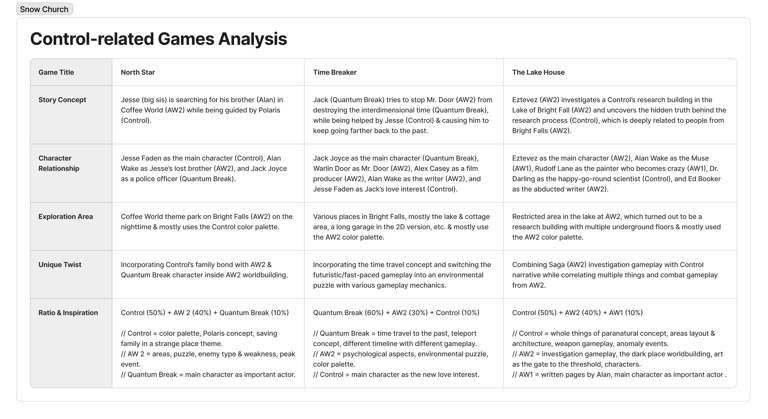
The backstory of Jesse and Dylan was INTERESTING.
The peculiarities of paranatural-related things: astral monster, astral planes, the board, polaris, etc.
The responsibilities of someone who came from a normal background which suddenly became a director felt like an imaginary release, which looked impossible to happen in real life.
The fun & unique fighting mechanics, which were awesomely delivered in the gameplay: adaptive gun, levitating, telekinesis, etc.
Amazing & grandiose brutalist architecture, which was rarely used in games.
Tons of interactable objects that uncovered deeper stories about the FBC & paranatural-related things.
Then, I continued the research to the next question: how will a multiverse look in Remedy's style? Fortunately, Alan Wake 2 expansion packs answer this question, so I studied them from a game development perspective.
Designing New Multiverse
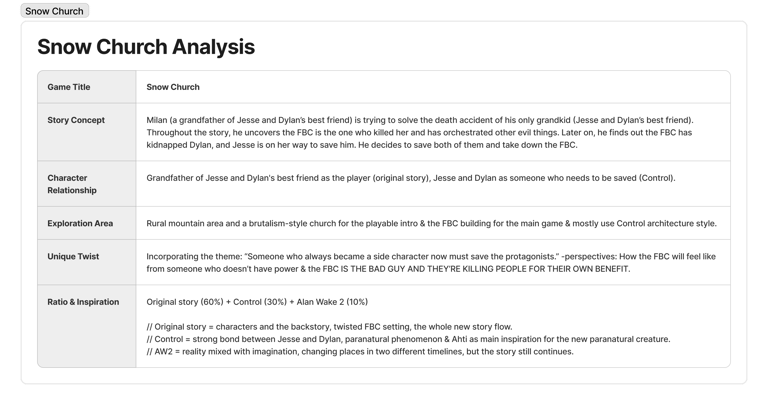
I noticed the core concept from Remedy's multiverse was combining different games in certain ratios inside a new story while maintaining each game's unique selling points.
So, to make a game feel Remedy-like, I must follow the same principles. Since the Control universe was already unique by itself, I wanted to create a moral twist for the FBC and things related to the Altered World Events (AWE) after The Ordinary incidents.
I kept The Ordinary event the way it was since it was a key aspect inside the Control universe itself. But I did create new backstories for Jesse and Dylan (original characters from Control) so they fit with the multiverse I worked on.
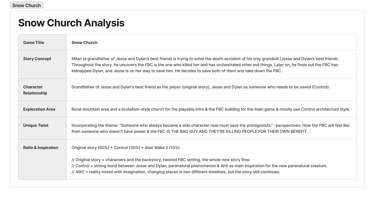
Player & NPC Concept
Player Name: Milan Cameron
Age: 62 years old
Milan is everyone's favorite grandpa because he’s fun, attentive, and kind. But because he’s an ex-cold case detective, he’s very critical, detail-oriented, and hardheaded about everyday-related things. He’s very sentimental for people he cherishes. He also has photographic memory that lets him remember everything in great detail.
Curious and an overthinker by nature, so he has a tendency to need to know everything before analyzing things.
Milan is old so he can't do fast-paced activities like young people, but his intelligence and memory are as sharp as his prime.
Haunted by the guilt of his granddaughter’s death because she probably wouldn't have died if she hadn't investigated the ordinary case alone.
Has deep emotional attachment to his late child and grandchild, so he tends to get emotional if there’s something that triggers his memory.
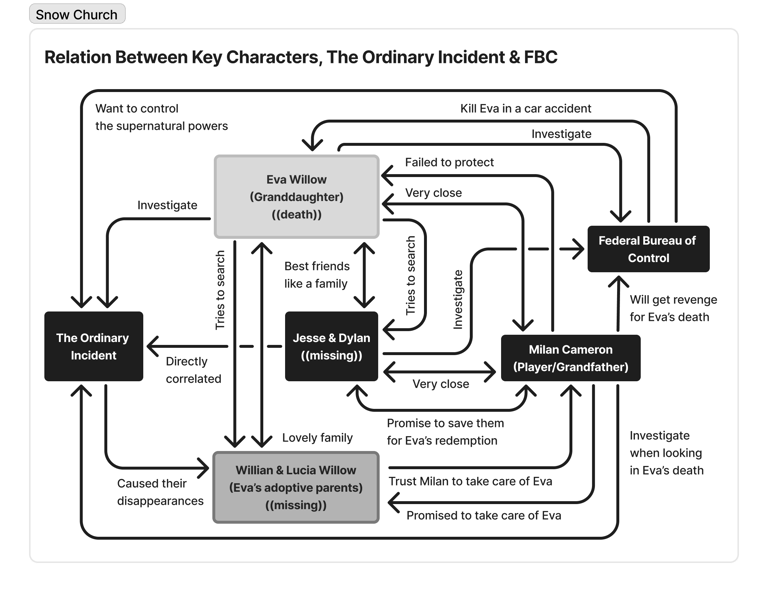
Player's granddaughter: Eva Willow
Age: died at 21 years old
Personality: strong-willed, free-spirited, loyal
Eva is free-spirited, distant, and doesn’t like being told what to do, so it’s very hard to get close to her once she doesn’t like someone. Knows a lot of people but only has a few close friends, and she’s very loyal to them. Absolutely hard-headed.
Granddaughter's best friend 1: Jesse Faden
Age: 28 years old
Personality: protective, helpful, adventurous
Jesse is the kind and protective friend who helps everyone; she has high initiative and likes to solve other people's problems even if they aren't related to her. She’s adventurous and likes to explore new places which rarely visited by people.
Granddaughter's best friend 2: Dylan Faden
Age: last seen when he was 10 years old
Personality: caring, shy, cowardly
Dylan is a friendly and caring friend, but he doesn’t stand out because he’s sensitive and shy. He likes to follow Jesse around and hide behind her if someone bullies him. He enjoys places with fewer people and likes to spend time with his close friends.
Granddaughter’s killer: Will Declan
Age: 32 years old
Will was a talented police officer which refused the offer to enter FBI because he prioritize his family over everything. He has low self-esteem and doesn’t fight back, making him become the perfect person for blackmailing. Eventually, he became tired of running and decided to stand for himself.
Player’s best friends
Age: 60-65 years old
There are 6 people who become lifelong friends with Milan, and they feel like a real family. They care for Milan in their own way and want to help him no matter what it takes.
Wife of the old couple: Lucia Willow
Age: last seen when she was 73 years old
Personality: worries a lot, attentive, strict
Lucia is an old housewife who loves kids; she wants to have a child, but her ovary is removed due to cancer in her younger age. Because of it, she’s very strict about a healthy lifestyle and clean environment. She’s friendly and likes to cook.
Husband of the old couple: William Willow
Age: last seen when he was 78 years old
Personality: carefree, independent, adventurous
William is a retired nature photographer who was famous in his time. Beside his adventurous nature, he’s independent and carefree. He likes to go to the local community center and have a lot of friends there. Like to do harmless pranks on people.
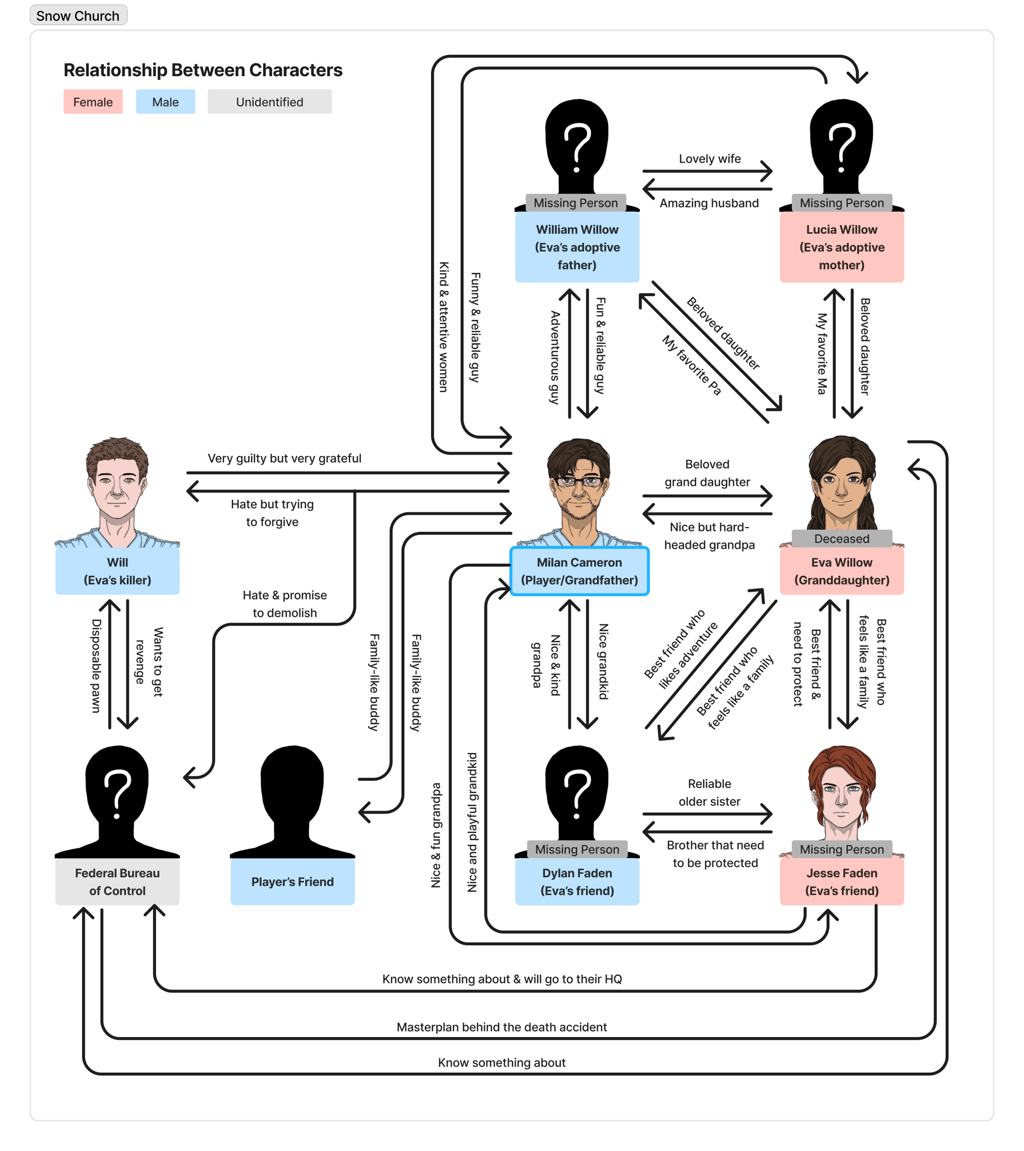
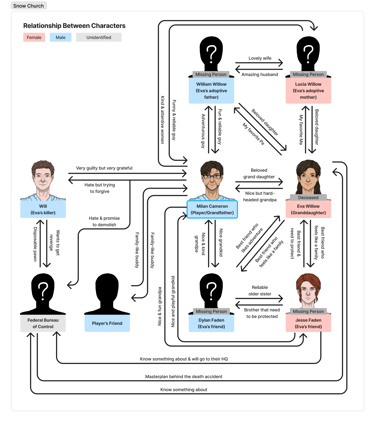
Characters Backstories
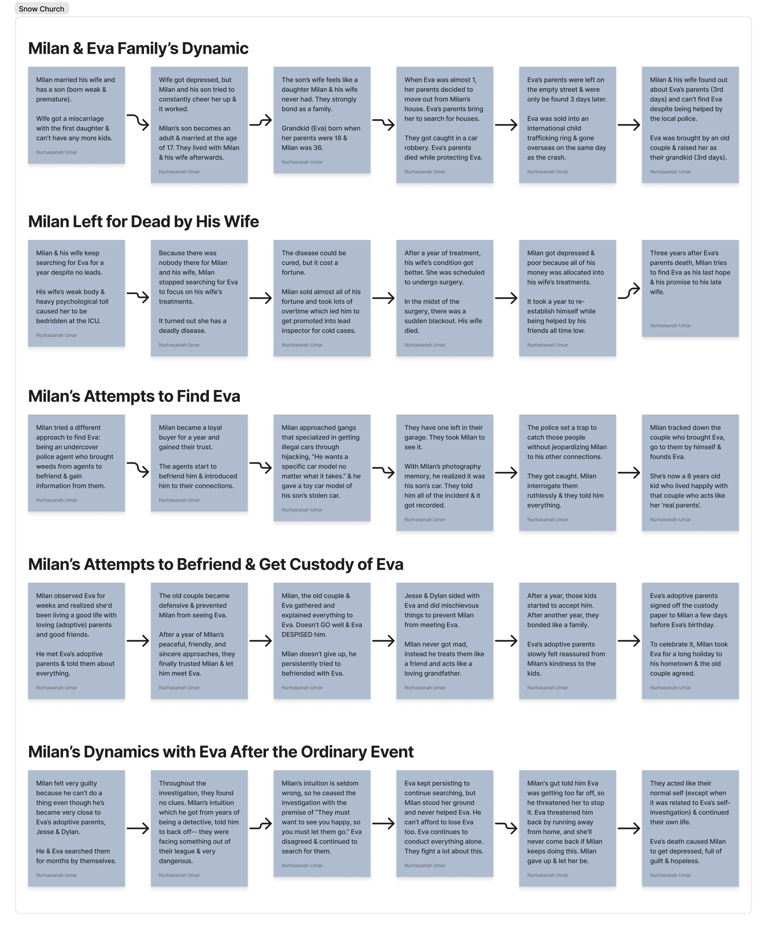
With the theme of 'reliving the past', backstories between the original characters from this multiverse and from Control became the core foundation of the narrative. So, I made sure there were causalities that connect every event of the past to what happens in the present time (though not everything will be revealed in this Intro to Act 1).
Guilt and misery became important aspects that built the backstories. In general view, it was the loop of unstoppable tragedies that killed someone the player's love → the player tried to make things better → things got better for quite some time → more unstoppable tragedies.
The repetitive depressive phases built the player into someone who's afraid of losing people who're dear to him, that was why he was fully determined to save Jesse and Dylan before being killed by the FBC.
Milan's Backstories
Milan is the main character in this story, so his background is deeply explained to give a full grasp of how he related to this multiverse of Control. This Intro to Act 1 won't delve deeper into it since the focus will be on how he connected with Jesse and Dylan from the original Control universe.
Eva's Backstories
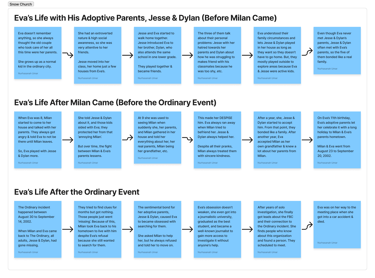
Eva is Milan’s granddaughter, who became the key that connects Milan with the Contol multiverse. She’s already dead, but the memories of her and Milan’s guilt are the ones who push him deeper to investigate the FBC.
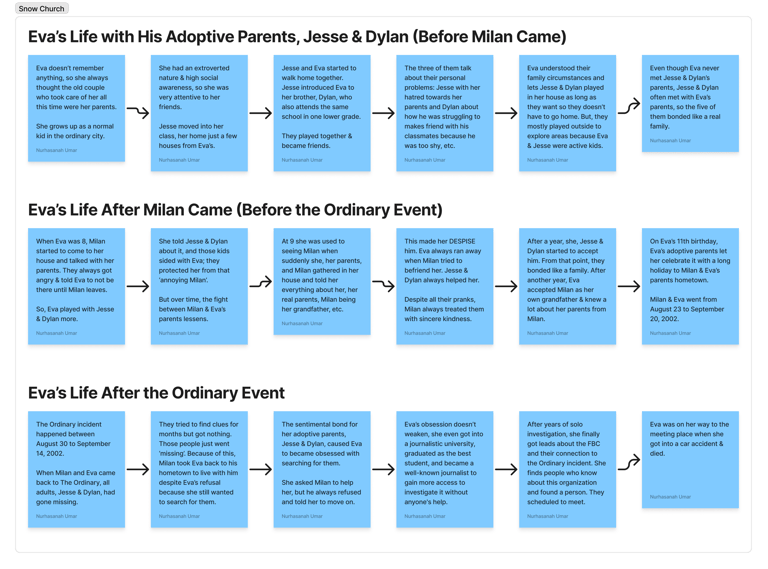
Adoptive Parents' Backstories
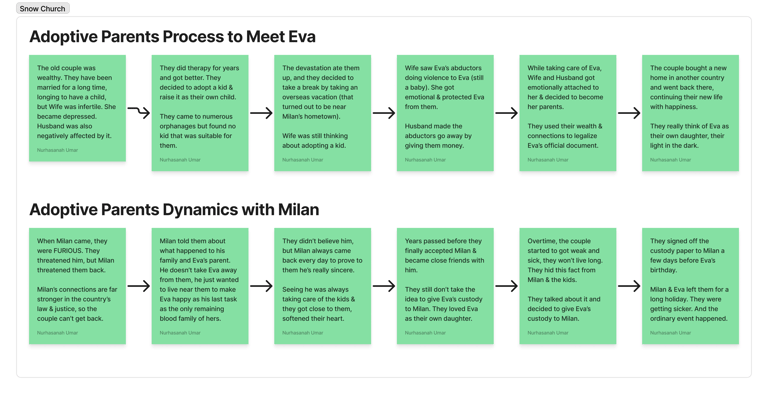
Eva’s biological parents had died since she was a child, so she spent her childhood with her adoptive parents. They disappeared in the ordinary event, and they’re one of the main causes who made Eva solo-investigate that event, which later leads to her own death, and Milan decides to take revenge on the FBC.
Jesse & Dylan's Backstories
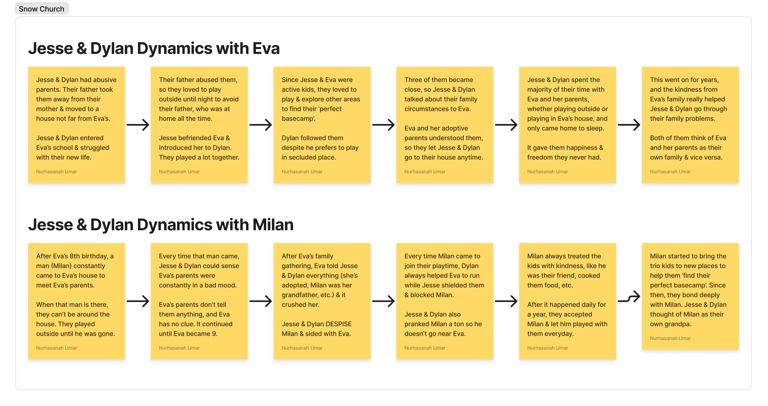
Jesse & Dylan are another key factor that caused Eva to investigate the ordinary events. They’re the only friends who helped her through her childhood, so they feel like her own family. Eva, Jesse & Dylan like to play together with Milan, so overtime, Milan thinks of them as his own grandkid.
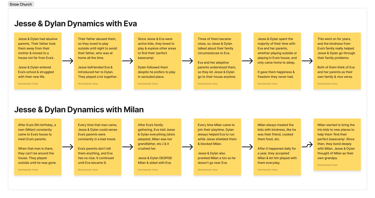
Inspiration From Musics
While writing the story, there are some songs that give me inspiration on how the storytelling should be delivered and what emotions must be present in it.

Livingstone - Half Life
Inspiration for: the old man's determination and kindness to save Jesse and Dylan before FBC kill them, even if he has to exchange his life to let them live a day longer.a

Martti Suosalo & Petri Alanko - Sankarin Tango
Inspiration for: the multiverse where Jesse becomes powerless and needs to be saved instead of becoming so powerful and saves everyone else.

I Prevail - Bad Things
Inspiration for: old man's photographic memory, where he can simulate and remember everything in his head, making it become it's own hell he can't escape from.

Figura Renata - Serdadu
Inspiration for: an old man who instead of peacefully enjoying his old days after lifelong hardship, he enters a path to hell to pay for his guilt's redemption.

Dax - Depression
Inspiration for: the hardship of an old man who has mental illness and can't fully accept nor let go of his past, so he clings to it even when it slowly kills him.
Story Progression
Since it was a multiverse but still had the same concept as the Control game, the Intro to Act 1 became an important factor to show the connections—the scope of the new multiverse and Control’s universe. Continuing the concept of ‘revisiting the past’, this multiverse connections were revealed through the player character’s monologue when he reminisced about certain aspects of his past.
The way the character narrated everything vividly in an emotional tone indirectly told the player that he was still trapped in guilt and really tried to redeem his sin. It let the player empathize with the pain while giving concrete reasons for the player’s motivation when the full game started.
Areas Scope
This Intro to Act 1 was combining two different timelines: the present and the past. Those two timelines connect when the player (in the present time) interacts with certain objects that trigger him to tell stories from the past.
Those stories were the investigation process to find the killer of the player’s granddaughter. And since it has different location settings—based on the investigation progress—the area scope for the level design would be too big for only one person to work on. So, I decided to limit the area scope of level design to be only on the present time, while there weren’t any limitations on how big the area scopes were inside the game writing.
While analyzing what area I should make, I realized from Future Siren and Black Puddle that I need more experience in making nature-themed levels. So, for the present-time story, it would happen in a secluded mountain area.
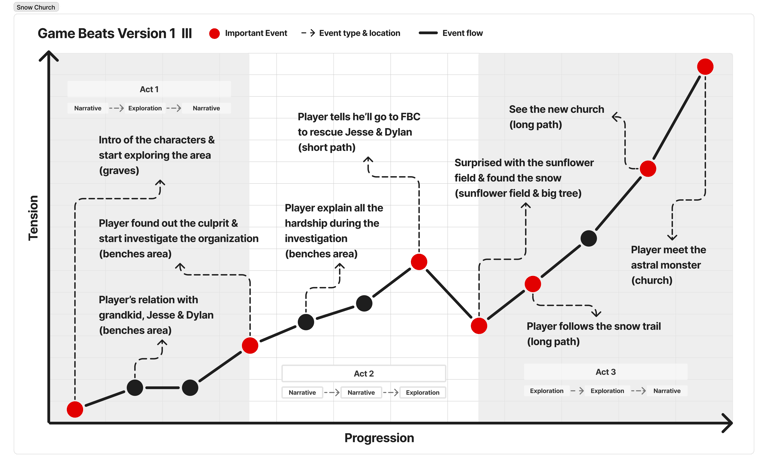
Since the only area that would be made inside the level design prototype was the secluded mountain (the present time to trigger flashbacks), the locations inside the game beats were adapted to the available areas inside the mountain instead of each location in the flashback.
In this Intro to Act 1, the intention was to fully introduce this new multiverse to the player, so the storyline was pretty straightforward with a gradual increase in tension without any flashbacks.
The story progression worked like an hourglass: tell the general info about the characters → problems from the past the characters had → resolution → problem in the present time that correlated with the past problems.
Game Beats V1
Mission Flow V1
Creating emotionally engaging gameplay was one of the main goals, so the missions should be actions that trigger sentimental memories = simple things that happened in the past and happen again in the present time.
Also, considering the player’s character was an old man, the missions should logically be doable for people of his age. So, I made the missions to be uncomplicated things that can be done in a secluded mountain.
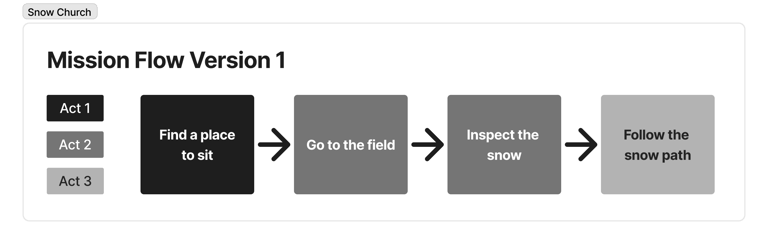
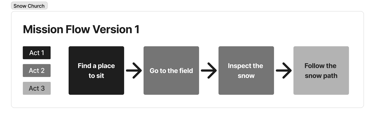
The missions also led the player to explore deeper into the mountain and investigate the anomalies that related to the AWE and original Control’s universe.
Screenwriting v1
Because the screenplay that was made based on the game beats and mission design was immediately implemented inside the level design, it made me know that not adding any flashbacks contradicted with the theme of ‘revisiting the past’. The monologue about the player’s past only made him sound like an old man who talked too much, it felt boring and didn’t create enough sentimental feeling for the story.
Furthermore, the missions felt flat, and it didn't maximize the potential of interacting with the environment. It resulted in an emotionally detached feeling with the environment, where it should've been the polar opposite since the place has lots of history related to the deceased grandkid, Jesse, and Dylan.
The screenplay felt nice if we only read it. But, it was really flat when it got implemented in the blockout. So, I must make a complete revision.
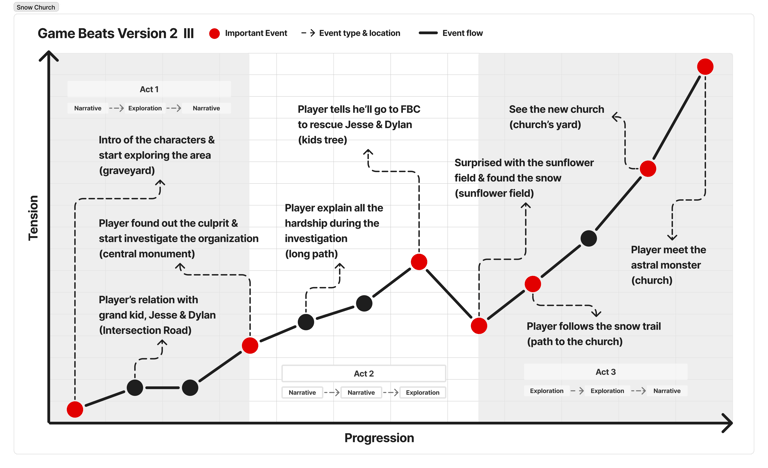
The general story progression already well accommodated on the previous game beats, gradually showed the correlation between the characters, the AWE, and the FBC. So, from the story aspect, there wasn’t anything that needed to be changed.
And, instead of the story, the changes happened on the locations of each event. It was caused by the total revision from the blockout process to enhance the gameplay experience while stabilizing it under the UE5 limitations.
The narrative adapted with this blockout progression and expanded the story in the second screenwriting process.
Game Beats V2
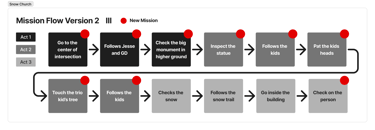
Mission Flow V2
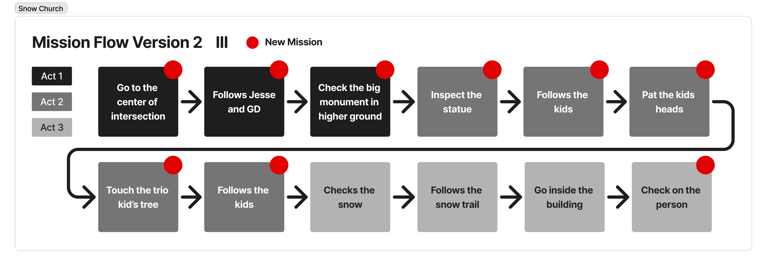
This second mission design went through a lot of changes to make the player engage deeper with the environment and showed the emotional memories of this place, all while connecting everything to the original Control’s universe.
Different from the previous version, where the player used his memory to guide him (missions) to go to certain areas/interact with certain objects, this mission design led the player with his vivid imagination that blends with reality—where the trio kids played led him to explore deeper into the mountain, interact with more objects, and trigger more cutscenes.
Screenwriting v2
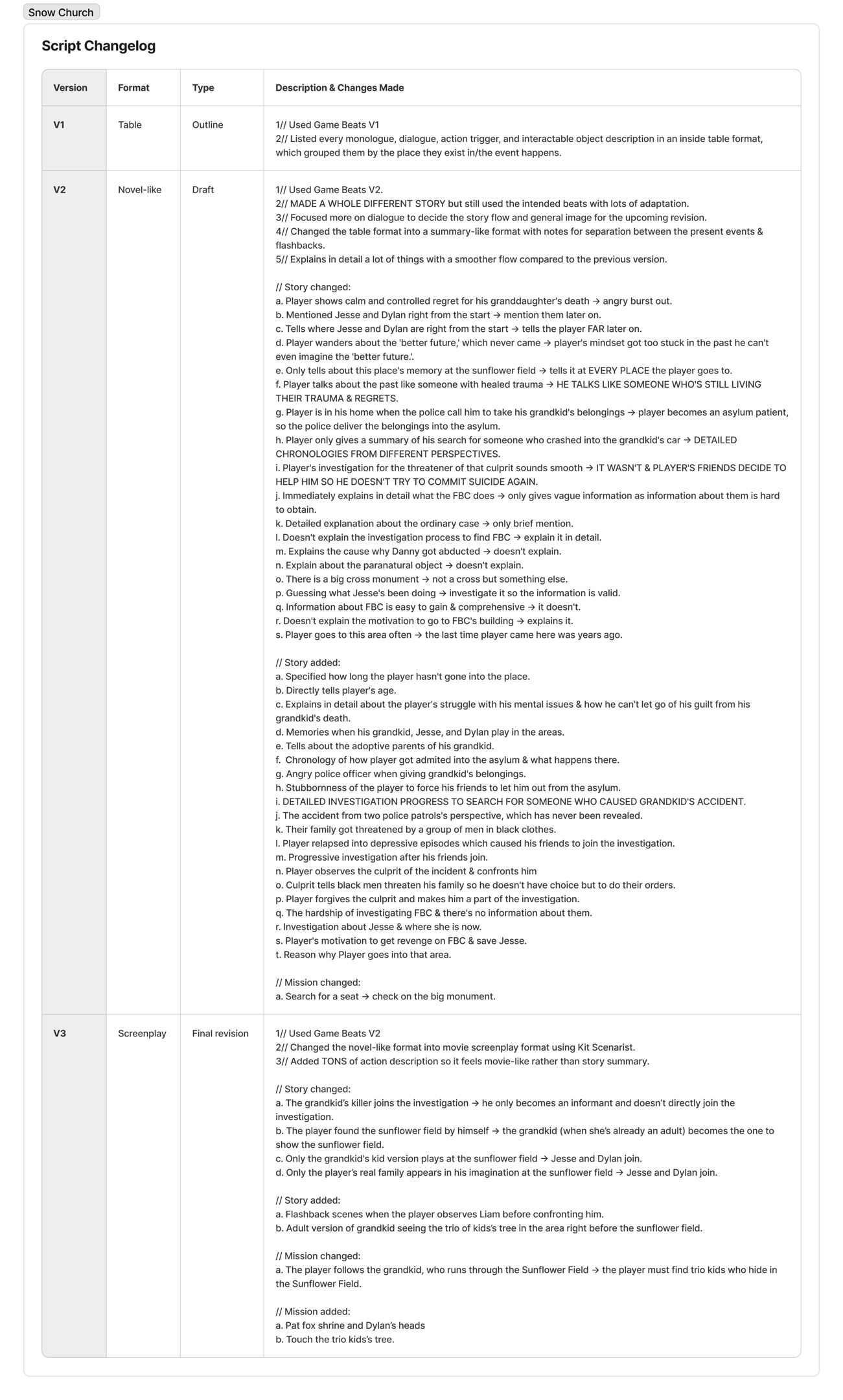
The new screenwriting was made based on the updated concepts and the playtest analysis from the blockout phase. It resulted in a massive revision of the screenplay.
It detailed the entire investigation process, created visual illusions of the trio kids (grandkid, Jesse, and Dylan) in the present time as the side effect of the player’s photographic memory, completely rewrote the exploration, etc.
And, yes. I realized this audio input needed visual scenes to trigger more emotions and maintain the player’s focus. So, there were tons of flashback scenes to show the player’s investigation instead of the player only talking about the recap of the investigation. This massively improved the story quality and gameplay engagement since everything felt dynamic and the player got included in every step of the story.
Also, instead of feeling like a walking simulator with an old man who kept talking nonstop, it felt like uncovering mysteries through interesting environment interactions and emotional detective-style that aligned with the character’s concept.
VISUAL References
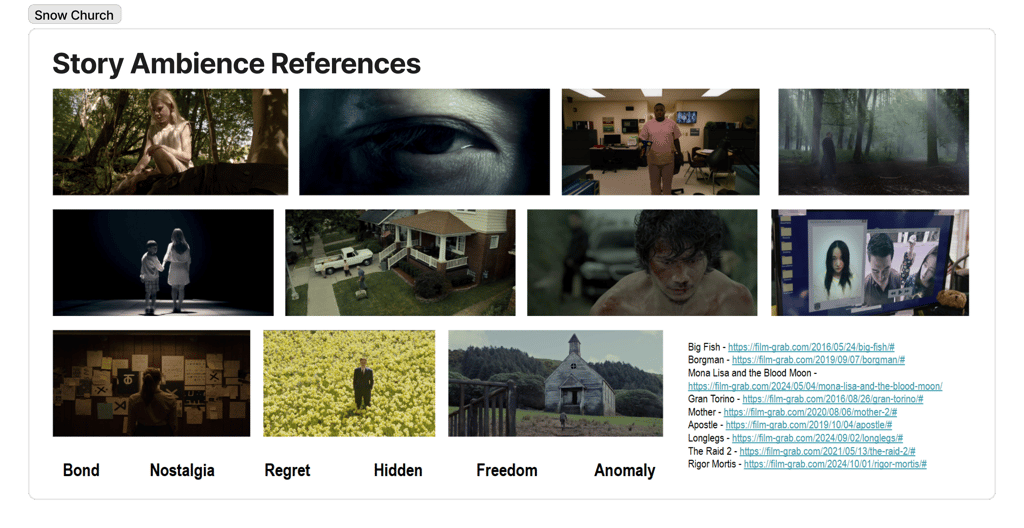
The moodboard covered the whole story ambience, so lots of them had a depressive tone from the narrative flashback.
While catching the moody ambience is mandatory, the color palette was not binding and could be adjusted as long as it conveys the intended emotions.
Since this project was also a fan-made IP expansion of Control, the production and development process should refer to the Control environment design, colors, and visual cues.
Script & Barks
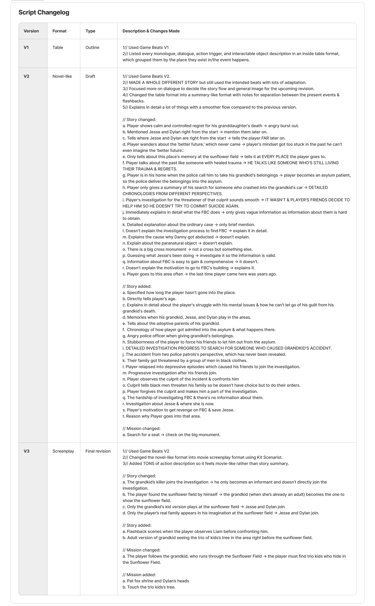
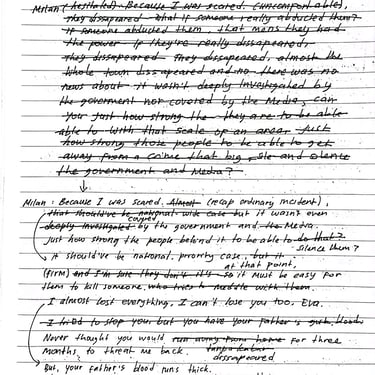
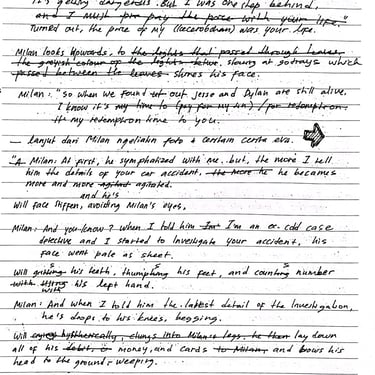
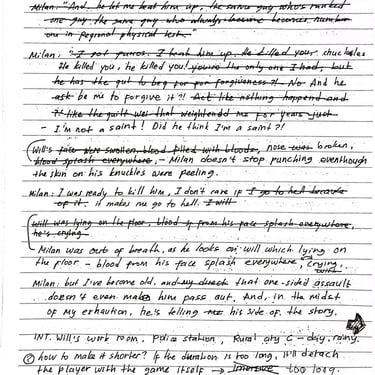
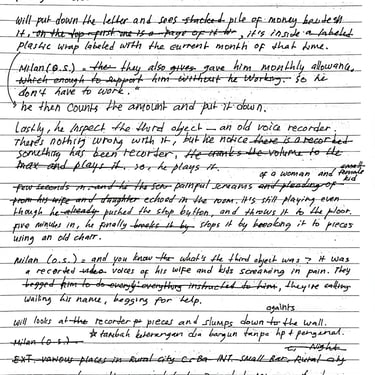
During the scriptwriting process, I did tons of manual writing to brainstorm and refine the ideas. It helped me to get better output since I already explored different possibilities before digitalizing the ideas.
Pardon the unrelated scribbles on the writing pics, as I made them in my collective gamedev sketchbook.
Implement Narrative Into Gameplay
I didn't have enough blueprint skill to implement every narrative directly in UE5, so I did the method that I used on my other four solo projects: video editing in DaVinci Resolve. I recorded the art pass gameplay (with interactable items and animated NPC spline) inside UE5 using OBS Studio and did post-process editing inside DaVinci Resolve to add subtitles, cutscenes, and audios. This resulted in a 5-minute gameplay prototype (160% speed) with implemented narrative.


Playthrough (Art pass)
This gameplay prototype shows how all game writing aspects got implemented into the whole gamedev pipeline. It also included scenes from the screenplay (the formatting was already adapted for gameplay usage) as cutscenes/another gameplay reference.
You can see the whole level design documentation to make this playthrough in here.
Things I’ve Learned
Making a fan project spin-off story from a pre-existing game has different development curves than making an original story. Same vibe & continuity is the key. Doing deep research to fully understand the original game is mandatory.
Finding the balance to make the story feel continuous but new & memorable is tricky. Explore different possibilities to find the most interesting and feasible ideas. Don’t get too stuck with the original story’s limitation.
The way the story is written and narrated is crucial. Don’t think the player knows everything, so we only need to point out key events. Think of them as someone who knows nothing, so we must deliver everything precisely to make them fall into the story without overwhelming them.
Depends on the development system inside the team and their skill set; the story might get directed based on other divisions, especially because the writing aspect is one of the easiest things to change compared to other aspects. Brace for merciless revisions.
Going back and forth between the story that happened in the past and the one in present time needs delicate control of pacing and subtle reminders between each timeline transition so the player won’t feel lost in the story.
A shorter script doesn’t always translate to a better story. First, focus on delivering the experiences of the story. Then, trim and refine the ideas to match the technical aspect of game feasibility & development process.
© 2025 Nurhasanah Umar. All rights reserved.