
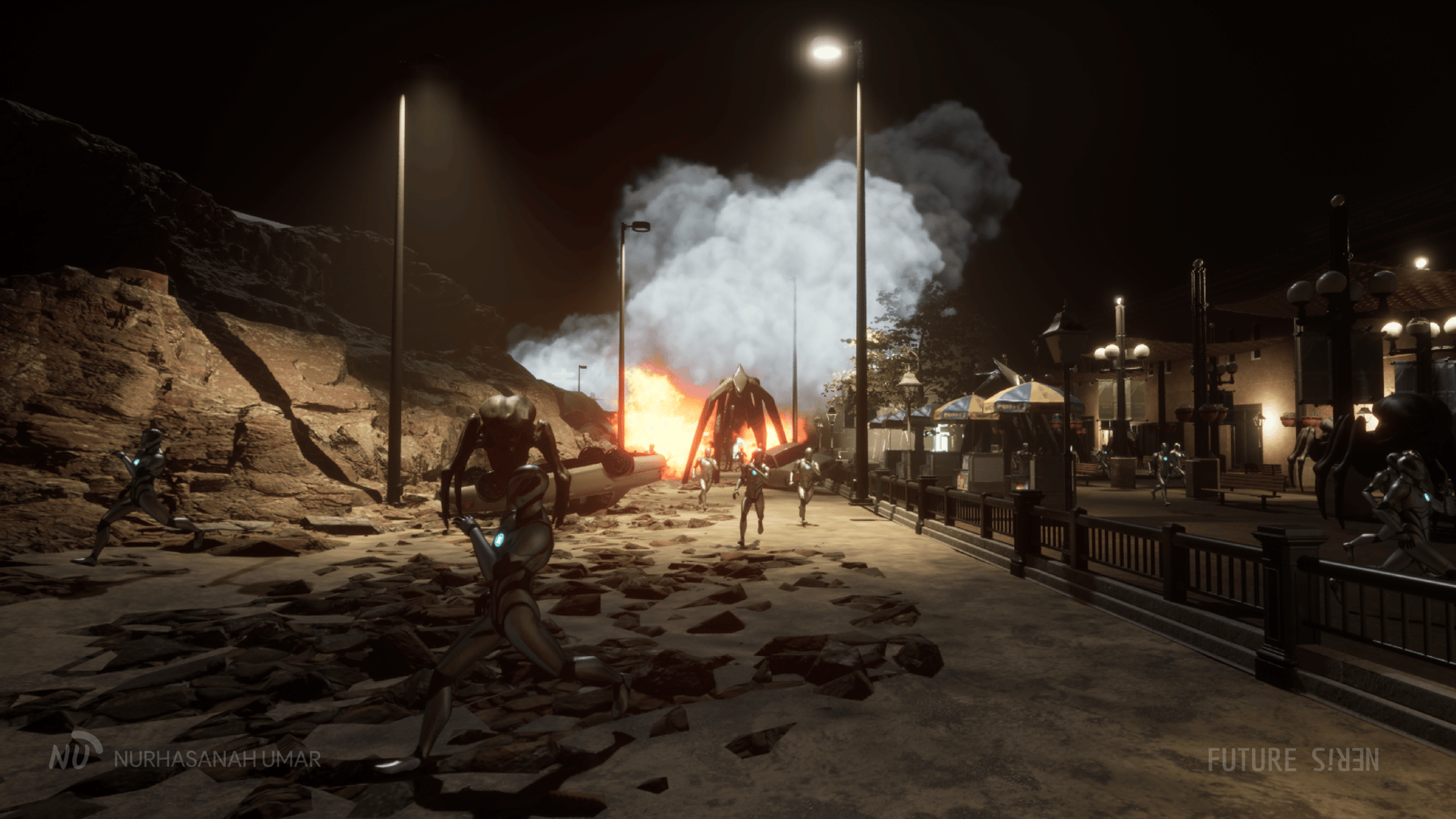
GW: Future Siren
Third-Person Shooter, Mystery, Action, Choice Matter
Notes:
This game writing project was made streamlined as the level design of Future Siren was made, so the playtesting phase on the level design directly affects the workflow and the game writing progress.


This was the second project/continuation of Taksa Semesta (original universe) and explored through the perspective of descendant of The Colaborator, whilst the first project was Black Puddle.
Overall View
Reading lots of mystery/crime novels naturally shapes my writing style towards exploration/detective style. But I know I must have high adaptability towards different themes and storylines. So in this second solo project, I made a branching narrative with fast-paced combat gameplay. I also need to prove that I can create a continuation story from an existing universe, so I incorporated Taksa Semesta (an original monster universe) from Black Puddle and extended it through different perspectives.
This idea started with a thought: ‘What if I make a continuation of Black Puddle, but it happens to different people at different times, and they experience different things because the person is a descendant of someone who made pacts with Taksa Semesta’s monsters? So, at a point in the story, the Black Puddle and Future Siren combined into a two-player game, and they played as both of the protagonists?
I know I can jump right to where the protagonists meet. But what I learned from analyzing AAA games is that one of the reasons why players deeply engage with the game is because they emphasize the player’s character, so it’s necessary to show them the backstory and give them motivations to play the game.
That’s why I decided to make this project into Intro to Act 1, which focuses more on those aspects.
Taksa Semesta: Worldbuilding
This project was the continuation of Taksa Semesta, so the worldbuilding stayed the same. You can see Black Puddle where it was explained in details.
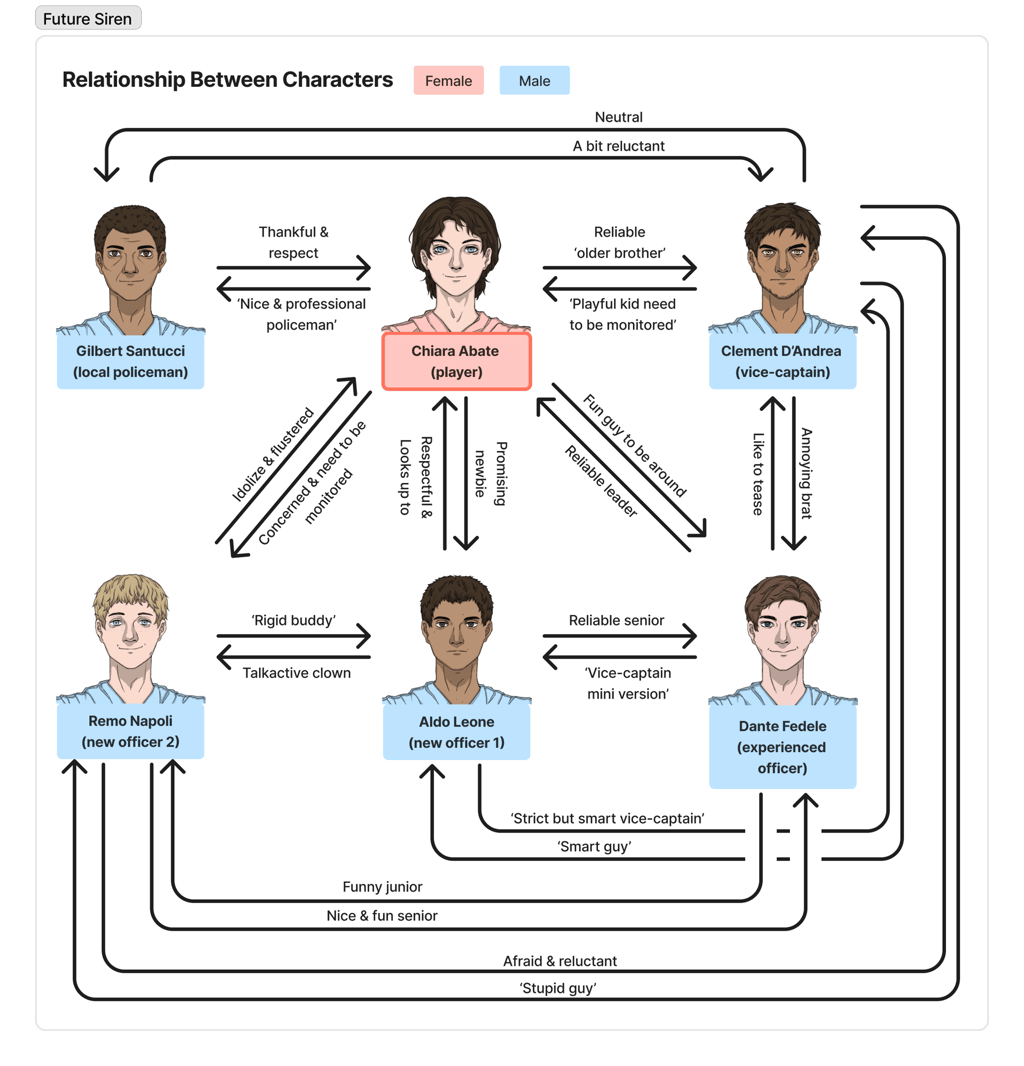
Player & NPC Concept
Player Name: Chiara Abate
Age: 32 years old
Chiara is a top-tier police captain who's well-known for solving an unsolvable cold case. She is smart, strategic, reliable, and supportive to her team members. But she tends to overthink and freeze under overwhelming pressure, causing her to be prone to doing hasty things and needing others to calm her down.
She's loyal, always makes sure no one is left behind, and tries to keep everyone aligned, causing her to be a very inspiring leader for her subordinates.
Being a captain trains her observation and problem-solving skills that focus on efficiency, so people depend on her to make fast and calculated decisions.
She takes her job very seriously and always stays professional around people she doesn't know that well, but she'll loosen up more to people she knows.
She's protective of her people and will go miles for them, and it also causes her to become more emotionally triggered if something happens to them.


Vice-captain: Clement D’Andrea
Age: 34 years old
Personality: straightforward, cold, but thoughtful
Clement is an introverted type of guy who is ignorant and cold to people he’s not close with, but he’s attentive and sensitive to people he considers important. He’s sarcastic but knows how to read the room. Very smart but doesn’t show because it’s troublesome.
Normal officer: Dante Fedele
Age: 29 years old
Personality: smart, funny, fast thinker
Dante is a muscular guy with a fast reaction response and a quick thinker; he’s not the routine and organized type of guy. He’s a social butterfly and likes to lighten the room using jokes. Has a tendency to be manipulated and become a people-pleaser
New officer 1: Aldo Leone
Age: 24 years old
Personality: analytical, loyal, self-centered
Aldo is a stiff and deep-thinking person, so he likes to analyze everything; his cold and straightforward approach often makes people feel uncomfortable. He’s getting ahead of himself a lot and tends to be self-centered. But he’s very loyal and helpful.
New officer 2: Remo Napoli
Age: 25 years old
Personality: clown in the circus, kind, talkative
Remo is not the smartest person in the room, but he’s the kindest one. A little bit slow in terms of analytical thinking but has high social skills, his warm and friendly personality makes him a fun person to be around but unreliable.
Local policeman: Gilbert Santucci
Age: 35 years old
Personality: considerate, responsible, polite
Gilbert is a diplomatic and hard-working guy; he understands hierarchy and knows how to position himself when facing different people. Sometimes he becomes indecisive, so he’s more of a follower and not someone who can make strategic decisions.
Story Progression
With the concept of branching combat that'll affect the story progression and the player’s discoveries, it means the player must fully understand this butterfly effect system so they can totally enjoy the game. I especially aimed to make each branching route fun and distinctive.
So, I decided to make this project as Intro to Act 1 to teach them about it along with other combat mechanics.
That being said, balancing everything out while making sure the story is fun to play became the main challenge in the game writing process. Seamless transitions and continuity between different branching routes also became important aspects that need to be implemented.
Areas Scope
My first project, Black Puddle, fully happened inside a building without any outdoor scene since I'm used to writing a similar theme. So, I wanted to push myself out of my comfort zone, that was why I decided to make this project fully happen outdoors.
When I was playing around in Google Maps and Pinterest to find inspirations, I realized seashore cities have an interesting mix of civilizations and nature. I checked the asset availabilities in the Unreal Marketplace and Quixel Bridge, and they had these kinds of assets.
Seeing the feasibility potential, I decided to use ‘seashore city’ as the area setting for the story.

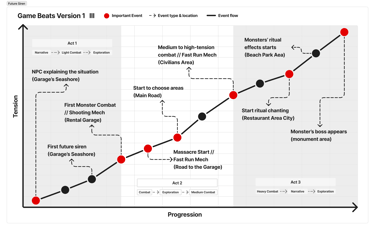
Despite being a branching narrative project, this game beats was made to facilitate the general progression of all routes. Also, being an Intro to Act 1 made introducing the current situation and teaching the game mechanics crucial, so I assigned them to the earlier phase—making the player get used to them throughout the remaining story.
To avoid overwhelming the player, I made them gain the abilities one by one: shooting (combat) → fast run (movement) → telekinesis (combat). This way, the learning curves won’t feel rushed.
Shooting being the first came from the consideration that FPS/TPS games were everywhere, so it won’t take much time to get used to it. Fast run became the second since it was only a faster version of normal running, so not much adaptation either.
Game Beats V1
Telekinesis became the last since it was the most foreign mechanic that needed more learning time, so the player could use shooting and fast run if they were still not comfortable using it.
Mission Flow V1
The missions were pretty straightforward: make the player explore areas to deepen the narrative and kill monsters to get used to the mechanics.
While conceptualizing the story, I realized one thing: despite the branching routes, the core thing the player did was the same—combat. It made me think that I only needed to make one mission flow but create it in different areas and narrative discoveries to show the distinction between each route.
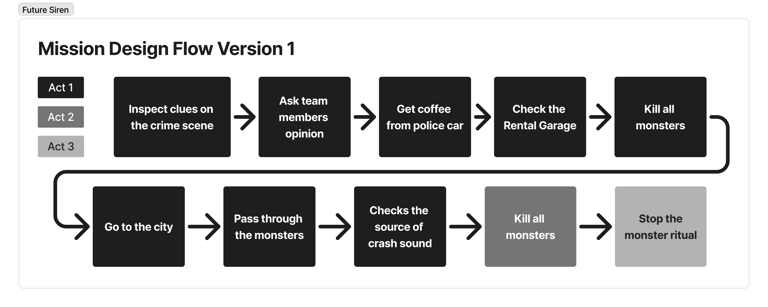
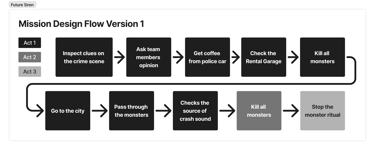
Besides expanding the narrative possibilities, this method also simplified the level design process since there wasn’t a need to create complex blockouts to facilitate various missions.
ScreenWriting v1
Those two concepts became the baseline of the first script. In the process of writing it, I realized how wrong my approach towards branching narrative was.
The same missions across different routes led to a monotonous storyline—there wasn’t any distinction between each path at all. This taught me that to create distinctive branching routes, each one had to be fundamentally different right from the concepting stage: the discoveries, type of monsters the player will face, combat difficulties, etc.
And so, because the first script I made didn’t provide any of those things, it was totally unusable. I must detail everything out, analyze and refine the concepts, and rewrite the screenplay to adapt to this new knowledge.
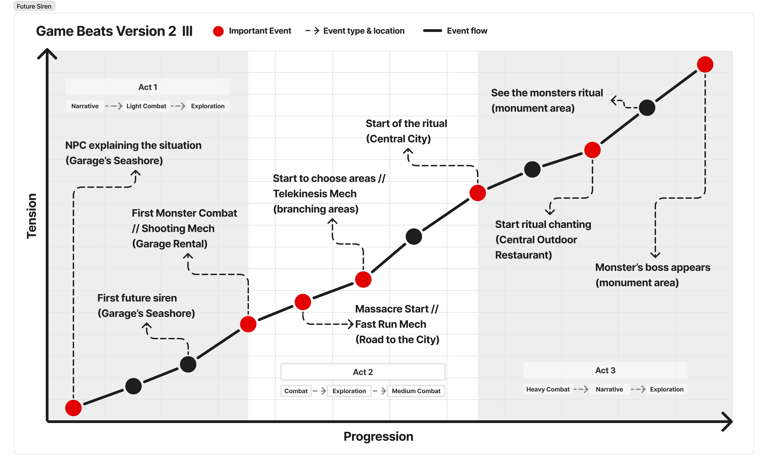
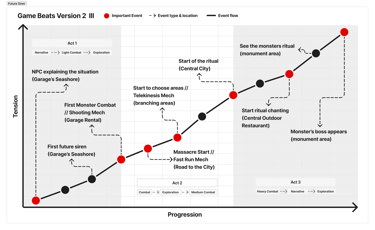
I deeply analyzed the previous game beats, trying to find flaws that needed to be refined. But then I realized the story progression was already well-balanced. The pace, the flow of the mechanics that were being taught, and the key events all were okay.
So, there were only minor changes on the game beats, and most of that came from the locations of where the events happened. The major changes happened inside the screenwriting process instead of the general game beats.
Game Beats V2
Mission Flow V2
The new mission design went through complete refinement to accentuate the branching narrative. I did tons of analysis on how big the scope of ‘different experience’ I would facilitate was and what kind of experiences they were.
And that led me to three types of gameplay: narrative-focused, balanced, and combat-focused.
The next question was: how do I facilitate all of them inside a seashore city? By creating different exploration areas that can only be explored if the player chooses it on the branching cutscene.
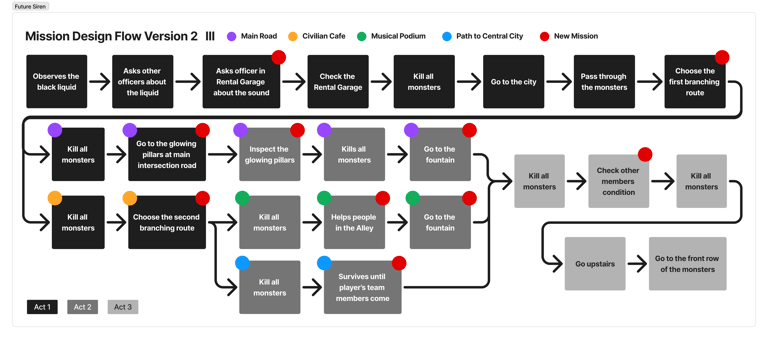
It took lots of research, brainstorming, and trial and error between the game writing and level design to decide this. But eventually, the result came out nicely—facilitating the extensive narrative, combat, and discoveries, all under the feasible scope of the level design—and here are the results:
Main Road Route: The player discovers the road blocked by glowing pillars that can't be destroyed, cars crashed into them causing fire, and hallucinations from getting near them—less strong monsters.
Musical Podium Route: The player only sees the glowing pillars and burned cars from afar and isn't affected by hallucination—more strong monsters and telekinesis props.
Path to The Central City Route: The player doesn't see glowing pillars or burned cars, or experience the hallucination BUT will see monster eating people—has the most strong monsters for aggressive gameplay.
This extended the number of available areas compared to the previous level design and made massive changes inside the screenwriting.
ScreenWriting v2
The new branching routes concept, different objectives based on the chosen routes, and flaw analysis of the first script made me do a major revision to the screenplay.
I made different discoveries, narrative progressions, environmental storytelling, and events that happened for each of the routes. I had inputted the page number details on each choice in the .pdf screenplay to ensure everything was easy to access. I also used a similar style to the Bahasa Indonesia poetic chant from Black Puddle, so it maintained the continuity of Taksa Semesta while exploring it from a different perspective.
Despite marginally increasing the script page counts, it wasn't a problem since it properly facilitated all narrative and gameplay needs. To make sure people who'll read the script won’t be confused, I created one intro page which included the branching missions flow so people can recheck it easily.
VISUAL References
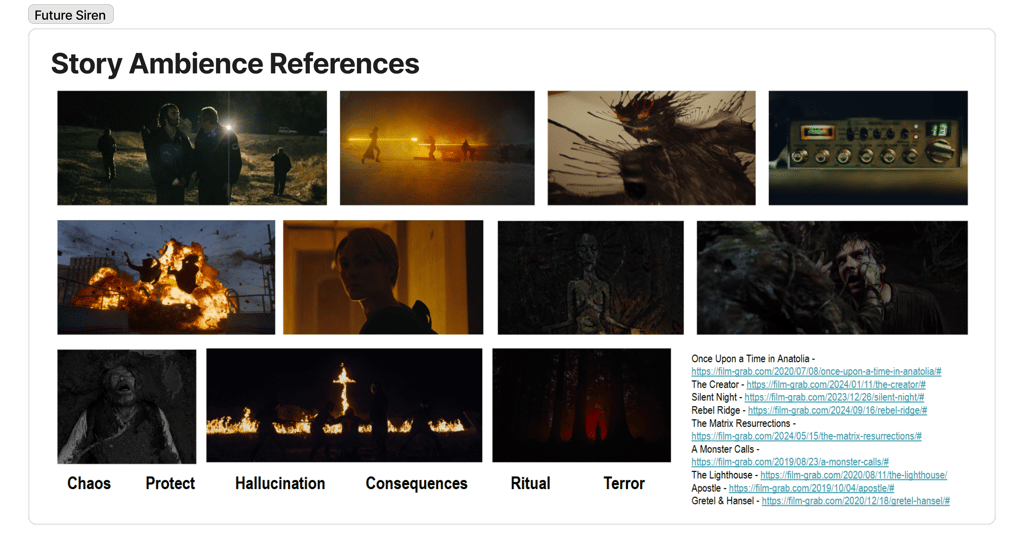
Different from Black Puddle's moodboard, which revolved around a mundane tone and safe feeling, this project did the exact opposite: dangerous and terrifying ambience.
This visual contradiction accentuated the different experience and narrative when the player in Black Puddle approaches the Taksa Semesta issue as someone who's not directly related to it, while in Future Siren the player has a bloodline correlation as the descendant of The Collaborators.
So, in this project, the ambience focused on enhancing the fast-combat tension that forced the player to think and adapt fast to the situations.
Script & Barks
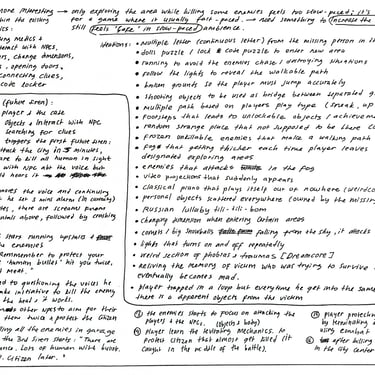
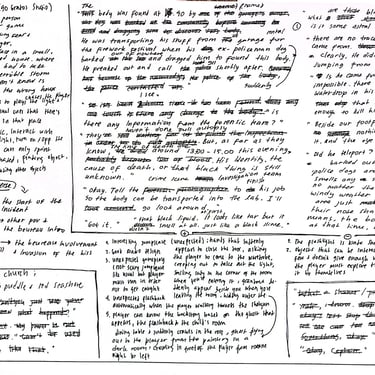
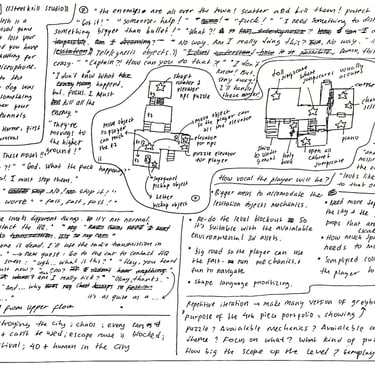
During the scriptwriting process, I did tons of manual writing to brainstorm and refine the ideas. It helped me to get better output since I already explored different possibilities before digitalizing the ideas.
Pardon the unrelated scribbles on the writing pics, as I made them in my collective gamedev sketchbook.



Implement Narrative Into Gameplay
I didn't have enough blueprint skill to implement every narrative directly in UE5, so I did the method that I used on my other four solo projects: video editing in DaVinci Resolve. I recorded the art pass gameplay (with enemies placeholder) inside UE5 using OBS Studio and did post-process editing inside DaVinci Resolve to add subtitles, cutscenes, and audios. This resulted in a 8-minute gameplay prototype (160% speed) with implemented narrative.


Playthrough (Art pass)
This gameplay prototype shows how all game writing aspects got implemented into the whole gamedev pipeline. It also included scenes from the screenplay (the formatting was already adapted for gameplay usage) as cutscenes/another gameplay reference.
You can see the whole level design documentation to make this playthrough in here.
Things I’ve Learned
One worldbuilding can be explored and deepened between different games. To make sure the second game doesn't feel repetitive, approach it through different perspectives and delve into things that haven't been explored in the first game.
Branching story = different experience between each route. If they teach the same gameplay mechanic, make sure each story and narrative feels memorable. Making different kinds of exploration discoveries also helps a ton.
Branching gameplay can explode the number of exploration areas. Make sure to discuss it with other team members (if you're not working solo) because the area's coverage will be affected by their skill sets and other real-life restraints.
The butterfly effect becomes an important aspect in branching stories. By combining them with the crime and punishment concept, the player will be more emotionally engaged as they feel the effects of their choices headfirst.
Psychological aspects that affect a player's decision-making can be intensified through roller-coaster pacing, short time limits when it's decision time, morally grey choices, etc. Mix them differently to keep everything interesting.
Make sure each route follows the key events and tension levels inside the game beats so it’ll be easier to track down, communicate between teams, and won’t confuse the players when they play it again and choose different routes.
© 2025 Nurhasanah Umar. All rights reserved.