
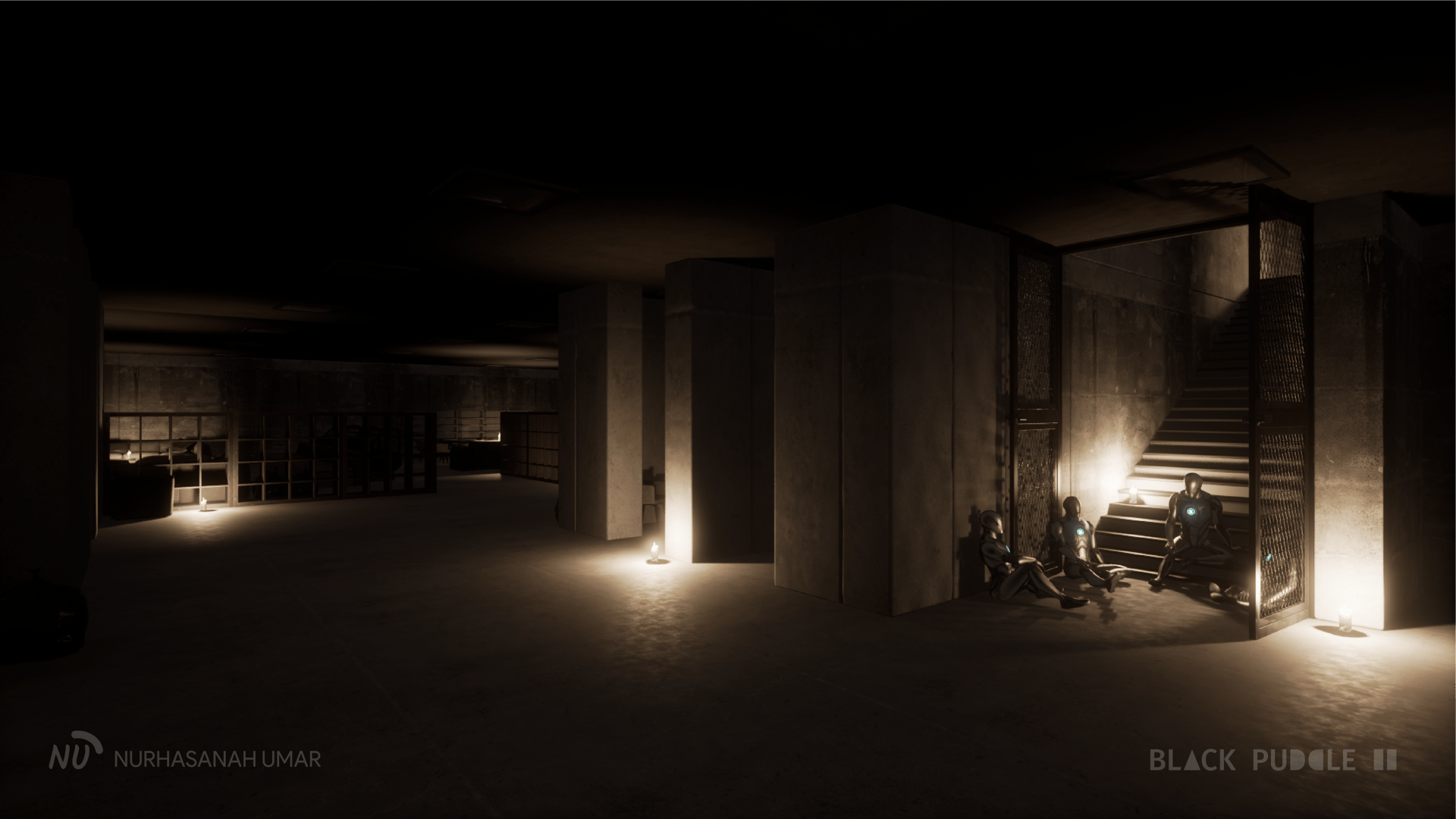
GW: Black Puddle II
Mystery, Suspense, Psychological, Drama

Notes:
After the concepting phase, the game writing progressed streamlined as the level design of Black Puddle II was made, so the playtesting phase of the level design directly affects the workflow and the game writing progress.
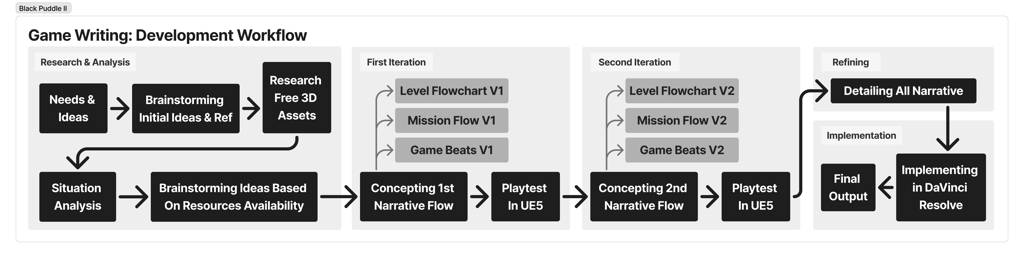
Overall View
10 Dec 2025 was the start of me using LinkedIn for self-branding before applying for jobs in the game industry. That was when I understood its 'competition.'
It was an unfair battle. I didn’t come from a game-related education, zero experience in the game industry, never (and was financially unable to) have a bootcamp or mentorship in level design and game writing, I didn't even have any mentors or connections in gamedev. And I must compete on the same ground as people who got all that?
It got to me, badly. I didn’t have external privilege to open the door, so the only way I could compete was through competence. My projects. Creating 4 solo projects wasn’t enough. I needed to do more.
That’s when I realized making the continuation of my first project as my latest project was the best way to showcase how far my skills had improved. And so, I decided to make a continuation of Black Puddle, both from game writing and level design, named Black Puddle II.
Brainstorming Ideas & Refs
This sequel of Black Puddle continued the journey of Nathan Miller as the main character/ player after he experienced his first Taksa Semesta (TS) event and became the new owner of the TS object.
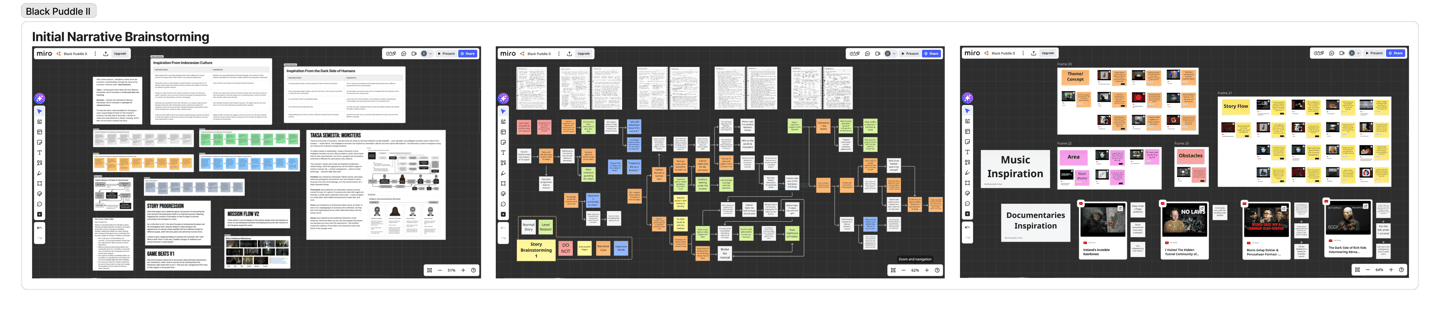
Documentary videos and music were used as inspiration to develop the first ideation. This phase explores various story possibilities based on the established TS worldbuilding and the previous story's themes to create narrative continuity for the Black Puddle project.
As the ideas brewed, the narrative progressively delved into the 'dark side' of mental illnesses of depression and trauma, portrayed through guilt-focused stories and the hardship to survive.
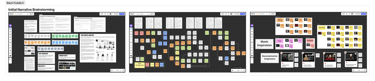
This developed further into dividing the gameplay into two worlds: real world and nightmare (when player falls asleep). It would become a torturous loop where player will be killed in each of the nightmares, and when he wakes up, he needs to survive from monsters and police who're searching for him as well.
The fusion of two story plots and worldbuilding into one cohesive gameplay made it narratively rich and engaging. It would also have stealth / combat gameplay in reality and escape in nightmares, making it fit with a wider audience.
This concept has a solid foundation, so I continued it into the next development phase.
Research Free 3D Assets
The final outputs of this project would be the same as my previous four solo projects (Black Puddle, Future Siren, Snow Church, Don’t Go Back): a gameplay prototype with implemented narrative and a full art pass version.
Meaning, feasibility to create the world up to the art pass phase inside Unreal Engine 5 only by one person became crucial. So, the narrative must adapt with resource availability.
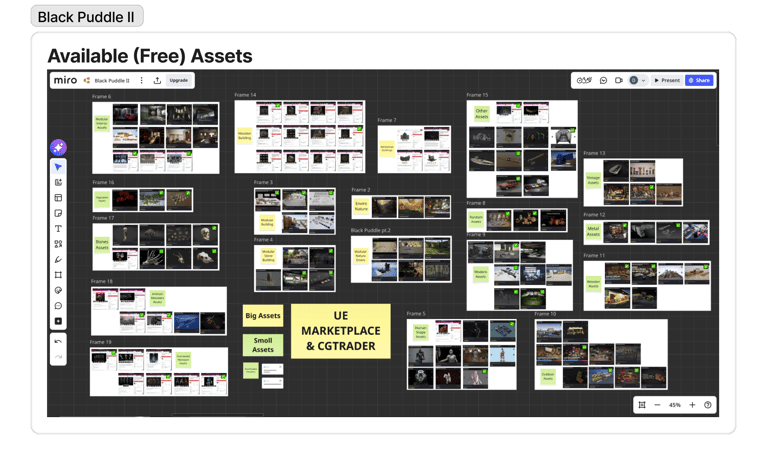
I did free asset research on FAB, Quixel, and CG Trader. Yes, there were lots of them with a wide range of categories. But the usable assets that fit with the narrative concept were very limited and the amount wasn't enough to implement it.
Situational Analysis
The idea was solid, but the resources showed it wasn't feasible to execute. There were two solutions to this problem: I could pay people / make the needed assets to ‘keep’ the initial concept. Or, I can adapt the concept to solve these limitations. Both have their own costs and benefits that'll affect the development process.
To decide on the solution, I imagined this project as a real game that’ll be released. It made me realize that it’ll be easier, faster, and more cost-effective to change the story instead of creating EVERY 3D ASSET to firmly follow the narrative. So, I decided to adapt the narrative to the assets.
Brainstorming Ideas Based On Development Situation
I re-approached the brainstorming by cross-checking the initial concept with the whole development situation and found problems.
The initial idea has an Indonesian theme for the nightmare world, but there were very few props aligned with it. The double timeline / narrative / worldbuilding was also too complex for a solo project. The whole story progression would also be too long for the intended one-hour gameplay to fit with indie game standards. In short, the project scope was too big and unrealistic.
I analyzed those constrictions, and it led to two solutions: condense the narrative into shorter story progression and focus on fewer narrative themes to prevent the future risk of scope bleed.
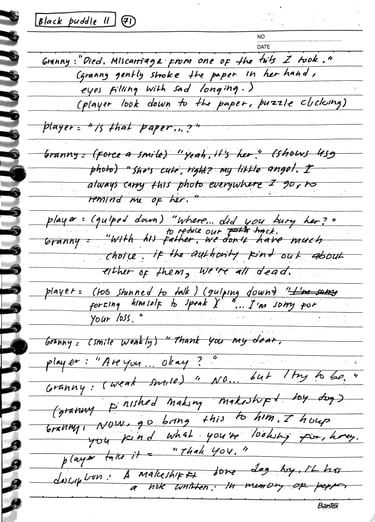
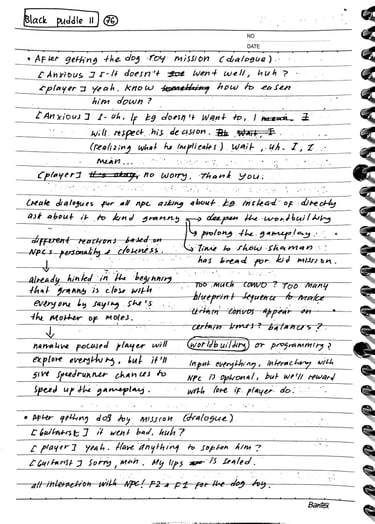
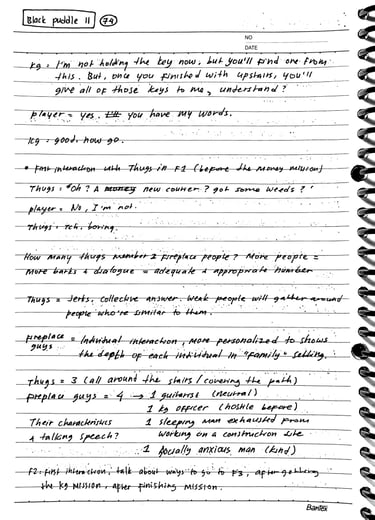
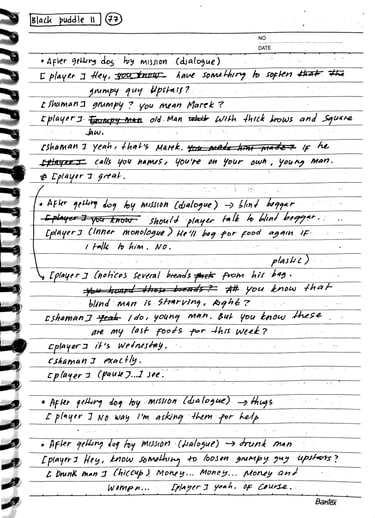
Those two became boundaries for the brainstorming. I manually wrote the ideation on B5 pages (spoiler: at the end of this project, I've written 105 pages) before digitally processing them in Miro to build a more structured concept. This process let me 'think twice' about the ideas and shaped them to be realistically feasible to be made within the development situation without sacrificing the narrative quality.
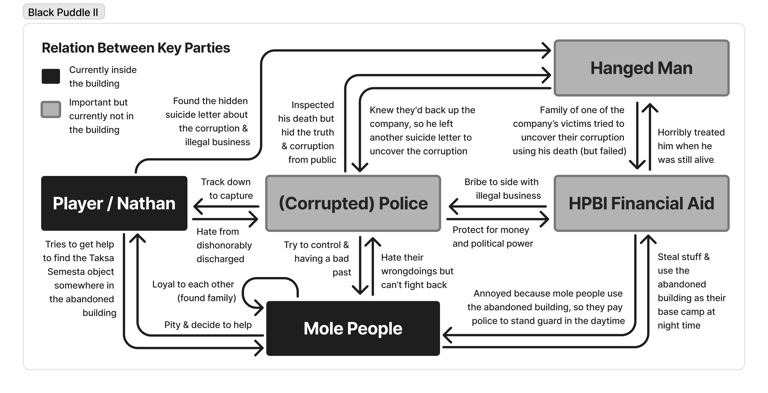
At the end of it, the gameplay was decided to be fully indoor, inside a big corporate building that had been abandoned and was being habituated by mole people at nights. As for the narrative direction, it focused on A.C.A.B., corruption, and how those destroy people's lives.


Concepting 1st Narrative
The narrative must bridge Black Puddle story, where player got dishonorably fired from being a cop after all the contributions he had made. So, I used A.C.A.B. theme to accentuate the dark reality of this 'honorable' job by making player engage with living victims of bad cops.
Aside from internally bad cops, the cops also team up with politicians and lawmakers to back up corruption at a national corporate level—making it an organized crime that’s being protected by people in power.
The story made player detest cops before he met a kid who idealizes cops and wants to become one because his life was saved by good cops, establishing a moral conflict between harsh reality and a child's innocence.
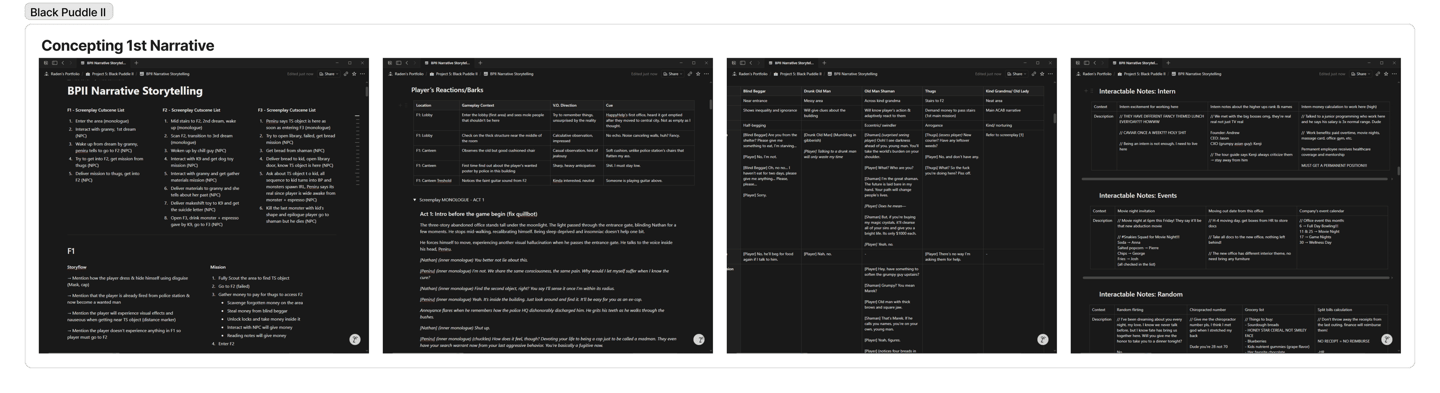
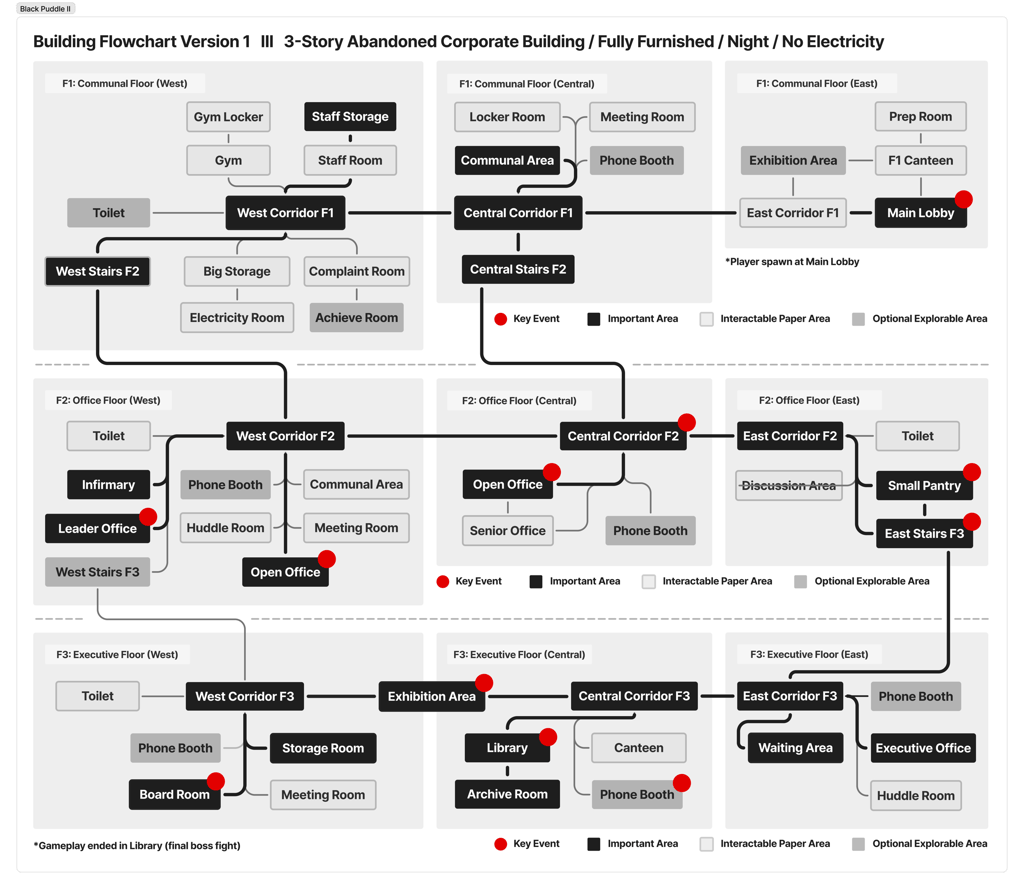
The level was designed to be big to show my level design's skill progression, so the narrative focused on making player interact with the whole map. This way, I could show how I made the narrative ‘shine’ on its own while also enhancing the level design / gameplay aspect.
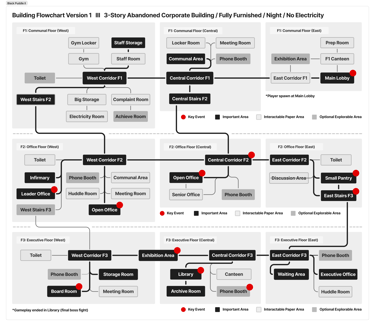
Level Flowchart V1
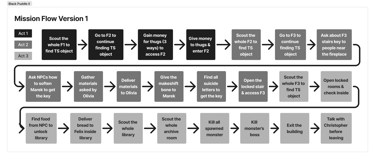
Mission Flow V1
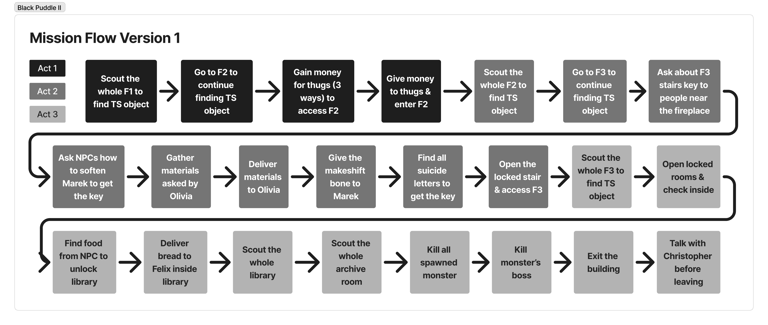
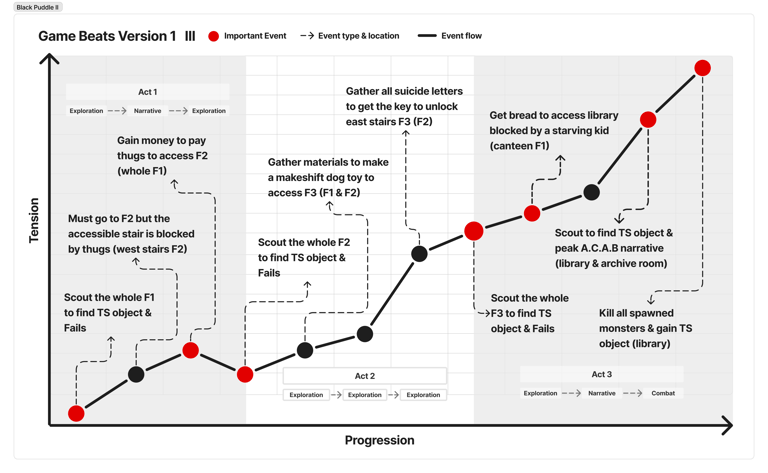
Game Beats V1
The missions followed the need to interact with the whole map: inspect places, find a way to access certain areas, interact with NPCs in different locations, etc.
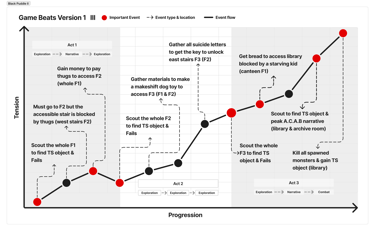
The gameplay was focused on exploration > narrative > combat and has a relatively slow tension progression (only 2/3 events that had a big increment). The combat also only happened once at the end of gameplay as a ‘nightmare’.
Playtest V1 in UE5
The narrative concepts (game beats and mission design that adapted with level design progression) felt ‘perfect’ on paper, but they became trash when they got implemented.
I overused the level design’s potential of a “big map with various rooms” and forced player to explore everything. This felt ‘okay’ on the first floor but became overwhelming on the 2nd and 3rd. It created gameplay that felt too long, boring, and repetitive, aka. recipe for disaster.
Meanwhile, the story concept and progressions felt 'meh' and didn't have enough variation. So, it must be revised along with the mission design to make the gameplay fun, reasonable, and enjoyable for different player types.
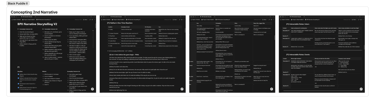
Concepting 2ND Narrative
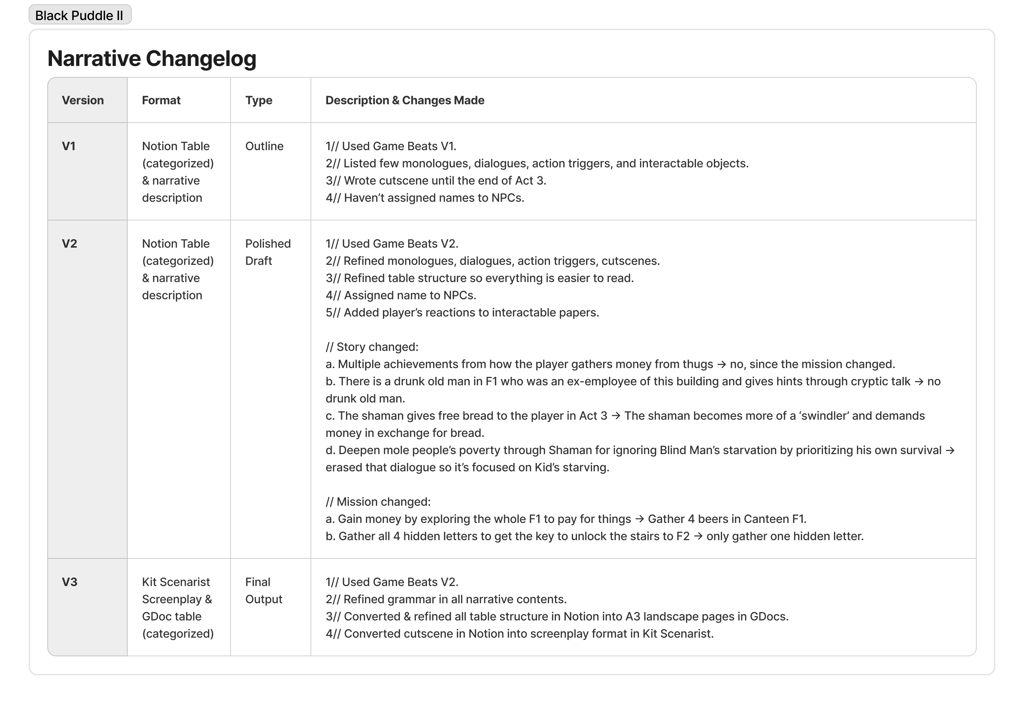
While the main themes of A.C.A.B. and corruption stayed the same, there were TONS of changes for the narrative contents (precisely in story progression, mission design, exploration scope, and gameplay phases).
This newer version has denser and shorter stories, focused more on 'memorably impactful' > 'wider variations.' It shrunk the 'main missions' that affected the exploration scope and created more diverse gameplay by making the player experience a 'combat nightmare' in Act 1 and Act 2 before the IRL combat in Act 3—instead of only doing combat at the ending.
Overall, it changed the whole narrative into a more intense bite-sized experience that aligned with the development needs.
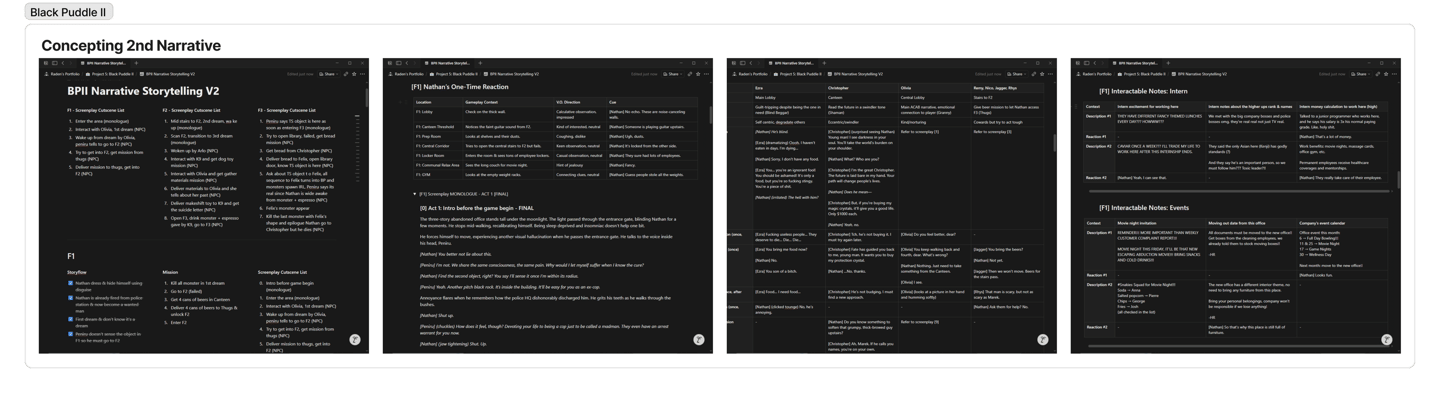
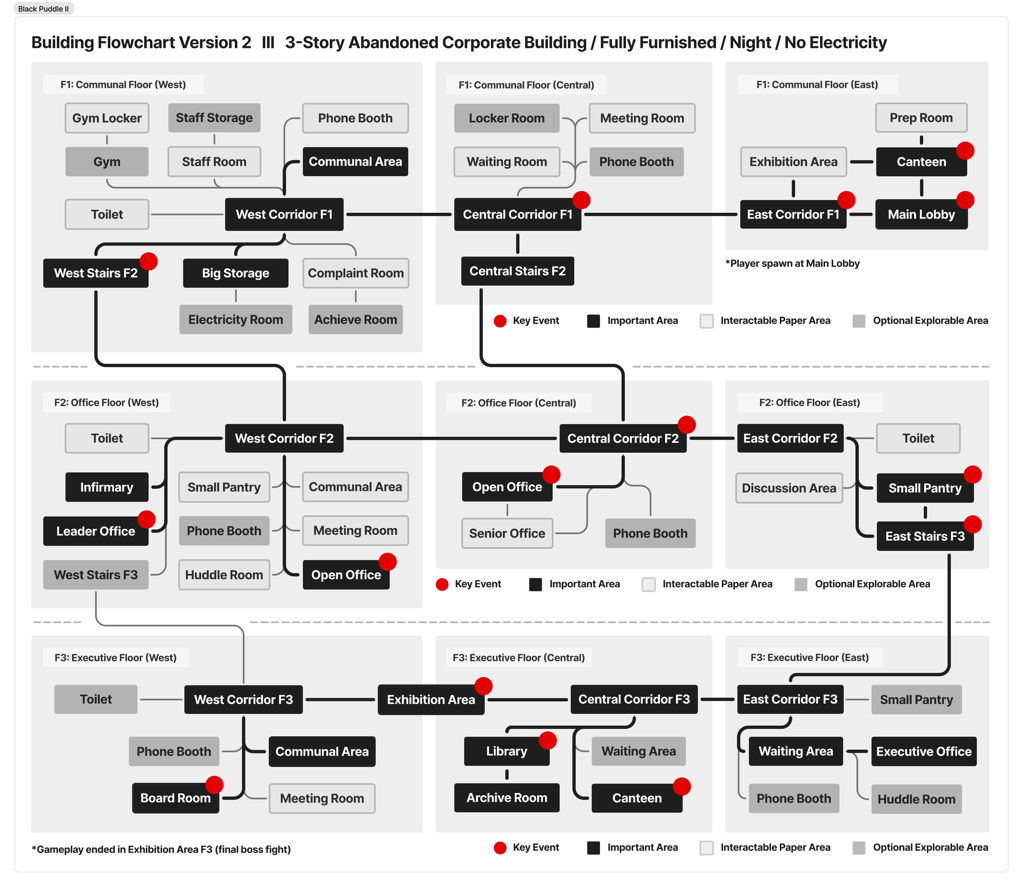
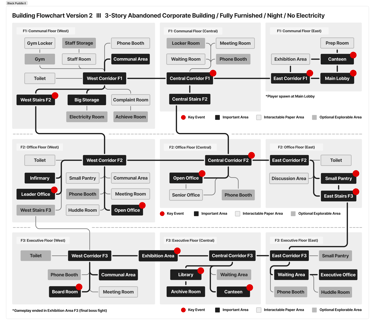
The level flowchart was made in accordance with level design progression, so there were adjustments in the importance categorization (adapted with the narrative changes) and room variety (added more explorable areas).
There were no major changes in the level flowchart, but the level layout did change to achieve a better gameplay experience. The new narrative concepts were also adapted with it.
Level Flowchart V2
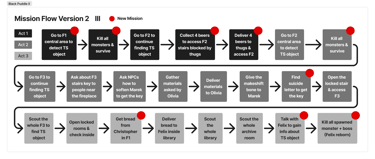
Mission Flow V2
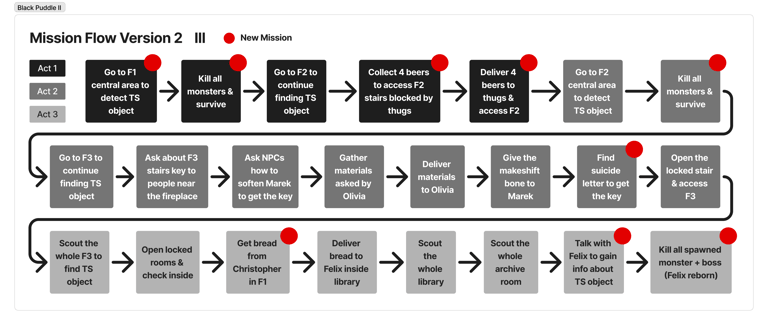
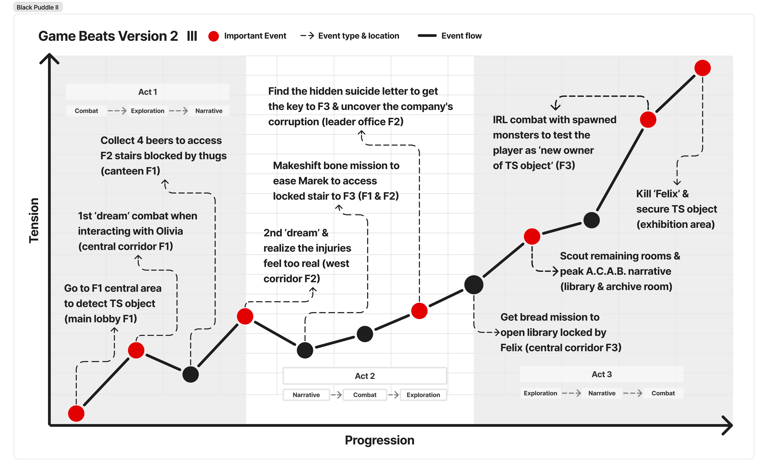
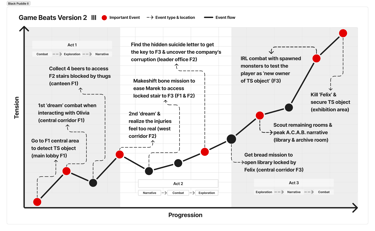
Game Beats V2
Instead of forcing player to inspect whole floors, the missions were adjusted to make player go to certain areas. This solved the overwhelming exploration, made it fun for players who don't favor exploration too much, effectively controlled the gameplay durations, etc.
The changes were massive. Now each act had different progression that balanced exploration, combat, and narrative gameplay instead of only focusing on exploration / narrative, and there would be combat in each act. This solved the repetitiveness problems by making it enjoyable and fun to play for wider player types.
Playtest V2 in UE5
The improvements were significant. It worked way better since it 'guided' instead of 'forced' the player, naturally balanced different kinds of gameplay and narrative implementations into the level, accommodated a wider spectrum of players with different playstyles, etc. In short, it made the game universally feel more fun and enjoyable to play. A massive success.
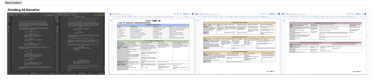
Detailing All Narrative
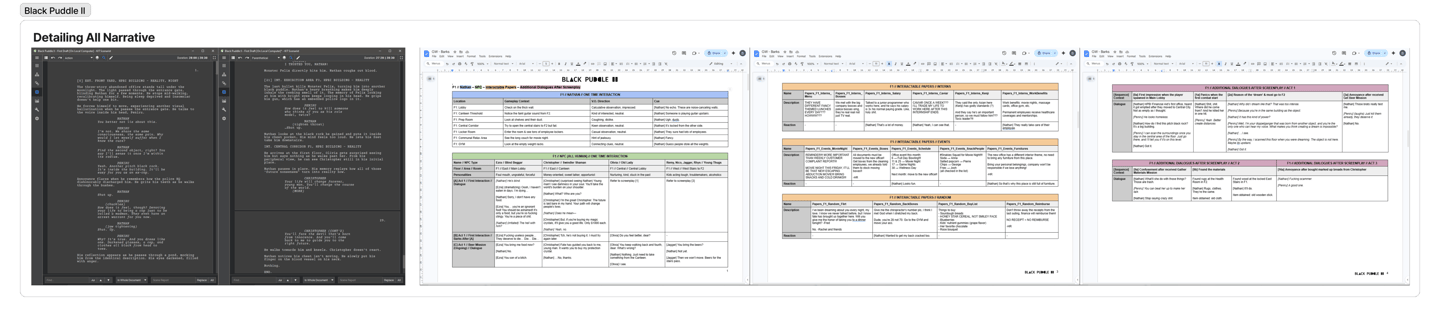
The narrative contents kept being refined to make it denser, more grounded with realistic descriptions, and the NPCs' characteristics felt more natural and personalized. To simulate a real game development process, I created various documentation structures that were easier to use by interdisciplinary development departments that have different needs. It made the narrative more applicable throughout the whole development process.
And, different from my previous solo projects (Black Puddle, Future Siren, Snow Church, and Don’t Go Back), in this project I only made screenplay-format narrative for cutscenes that would have pre-rendered animation footages to minimize miscommunication between the teams.
Player & NPC Concept
Player: Nathan Miller
Age: 28 years old / male
Same protagonist as Black Puddle project. After experiencing a traumatic event with Taksa Semesta (TS) and becoming the 10th owner of TS’s object, Nathan got disrespectfully fired as a detective for aggressive behaviours. Now he’s a fugitive with an active arrest warrant.
He becomes an insomniac from always getting nightmares every time he falls asleep at night, whilst he must run away from the police in the daytime.
The TS event caused him to often hear Peniru’s voice (his dark doppelgänger with corrupted morals) inside his head, which can’t be heard by other people.
Wary and observant, always connecting the dots of clues inside his head, but he keeps his thoughts to himself and is not hasty to make a decision.
Kid: Felix
Age: 8 years old / male
Characteristics: naive, idolizing cop, positive vibes
Broken home kid that got rescued by a cop, so he gets obsessed with being one. Being taken care of by Marek and Olivia in the mole community.
Old Lady: Olivia
Age: 62 years old / female
Characteristics: nurturing, kind, stuck in the past
Mother figure of the mole people. Attentive, caring, has a traumatic past with a cop, and always brings a USG photo of her deceased baby.
K9 Officer: Marek
Age: 42 years old / male
Characteristics: hostile, protective, observant
Loyal leader of mole people that killed Olivia’s boyfriend (a cop) to protect her. He hates cops for making him divorced from his wife and killing his K9 dog.
Swindler Shaman: Christopher
Age: 38 years old / male
Characteristics: money-oriented, sweet talker, opportunist
A stingy man with real foreseeability. But his traits make him look like a lying swindler that talks gibberish to make people buy his things.
Blind Beggar: Ezra
Age: 54 years old / male
Characteristics: foul mouth, ungrateful, forceful
An old man who demands help from others. Will call names and degenerate other people even when he depends on others to stay alive.
Young Thugs: Remy, Nico, Jagger, Rhys
Age: 14-17 years old / male
Characteristics: kids acting tough, troublemakers, alcoholics
Street kids acts tougher than they actually are. Individually weak so they always go anywhere together to feel strong.
Guitar Guy: Arlo
Age: 30 years old / male
Characteristics: chill, nonchalant, considerate
Ex-guitarist that joined the mole community to hide from the loan shark. Become chill from totally giving up his life and dreams
Anxious Guy: Cade
Age: 28 years old / male
Characteristics: kind, loyal, awkward
Socially anxious guy that tries to get better at it so he can have friends. Kind at heart but afraid he’s bothering people.
Sleeping Guy: Silas
Age: 38 years old / male
Characteristics: hard-working, self sacrifice, family guy
Workaholic that always pushes himself until he passes out. Always working to provide for his wife and two kids despite low wages.
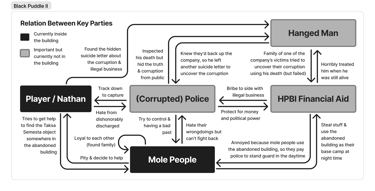
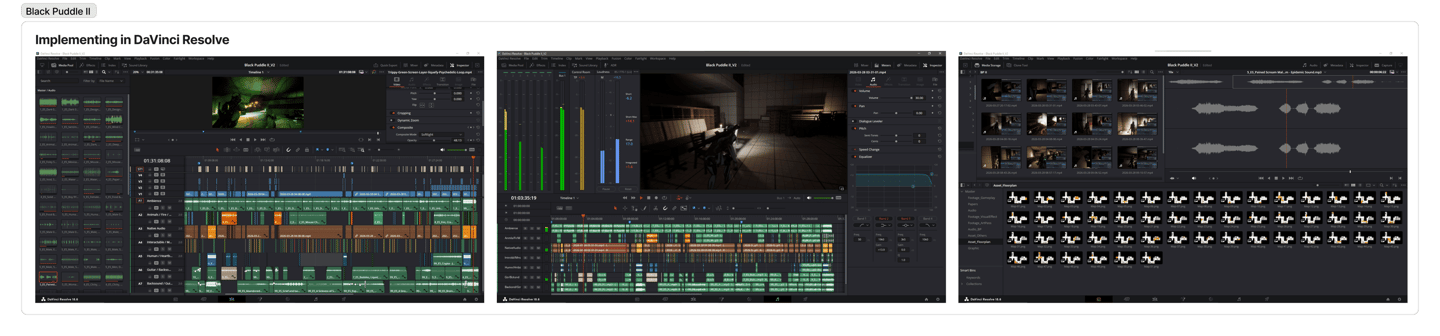
Implement Narrative Into Gameplay
I didn't have enough blueprint skill to implement every narrative directly in UE5, so I did the method that I used on my other four solo projects: video editing in DaVinci Resolve. I recorded the blockout gameplay (with interactable items and enemies placeholder) inside UE5 using OBS Studio and did post-process editing inside DaVinci Resolve to add subtitles, cutscenes, and audios. This resulted in a 31-minute gameplay prototype (100% speed) with implemented narrative.
Playthrough (Blockout)
This gameplay prototype shows how all game writing aspects got implemented into the whole gamedev pipeline. It also included scenes from the screenplay (the formatting was already adapted for gameplay usage) as cutscenes/another gameplay reference.
You can see the whole level design documentation to make this playthrough in here.
Things I’ve Learned
Narrative must be developed effectively within a short amount of time, hourglass method works great for this. Quantity → adapt to development situation → quality. It maximize ideas exploration and implementations to gameplay.
The game will be played by different types of players, so always think about how to balance the narrative to accommodate a wider type of player, even if the game was designed to be narratively heavy.
Continuously 'forcing' the player to do repetitive tasks will overwhelm and 'trap' them to think that they can't do anything. Ideally, a narrative should 'guide' and 'give options' to a give sense of freedom.
Narrative data will be referenced by other development departments, so making sure everything is easy to understand becomes crucial. Nice visual structures / documentations with simple descriptions help to convey the information.
Creating lots of narrative data that turns out won't be used in the development process is very annoying. So, just create a narrative based on who'll use it. Example: Not everything must be made into a movie-standard screenplay since people will only use a visual flowchart inside Miro.
Narrative tend to be the easiest aspect to change inside development cycle. So, most of the time, it must adapt and 'back up’ the gap / flaw created by other dev phases (even if it took a massive amount of time to create those narrative concepts). That’s just how it works.
© 2025 Nurhasanah Umar. All rights reserved.